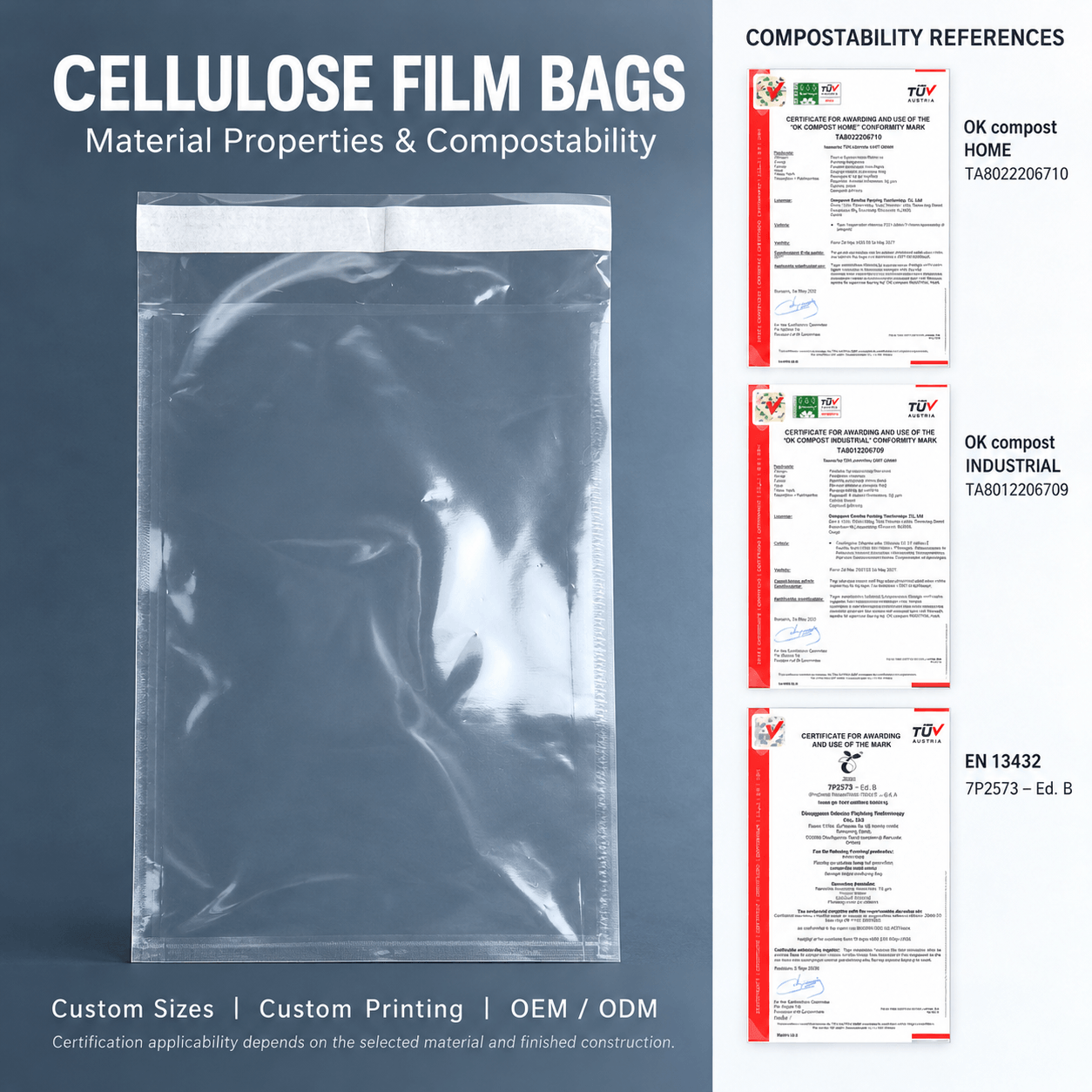
Are Cellulose Film Bags Compostable? Understanding Industrial and Home Composting Under PPWR

Are Cellulose Film Bags Compostable? Understanding Industrial and Home Composting Under PPWR
As apparel brands explore more sustainable packaging options, cellulose film bags are attracting attention because of their plant-based origin, transparent appearance, and potential for biodegradation under appropriate conditions.
However, choosing cellulose film packaging involves more than understanding its material source. Buyers also need to know how composting works, the differences between industrial and home composting, and how compostable packaging relates to the EU Packaging and Packaging Waste Regulation (PPWR, EU 2025/40).
For apparel brands, the key question is not simply whether a packaging material can biodegrade, but whether the finished bag is suitable for a specific disposal system and meets the applicable regulatory requirements.
1.Questions
Q1: What are cellulose film bags made from?
Cellulose film is generally made from regenerated cellulose derived from plant-based raw materials, such as wood pulp. It is used to produce transparent packaging films for clothing, accessories, and other products.
Q2: Are cellulose film bags compostable?
Some cellulose films can biodegrade under appropriate conditions and may be suitable for composting. However, the compostability of a finished bag depends on its complete composition, including coatings, inks, adhesives, and closure components. Product-specific testing and certification should be checked before making compostability claims.
Q3: What is the difference between industrial and home composting?
Industrial composting takes place in professional facilities with managed temperature, moisture, and aeration. Home composting takes place in household compost bins or gardens, where conditions are less controlled and decomposition is generally slower. Industrial composting certification does not automatically mean a product is suitable for home composting.
Q4: Does PPWR require all apparel packaging to be compostable?
No. PPWR does not require all packaging to be compostable. Article 9 identifies specific packaging categories subject to compostability requirements and provides conditions under which Member States may extend such requirements to certain other packaging. Other packaging, including biodegradable packaging outside those categories, must also be considered under the material recyclability framework in Article 9(3) and Article 6.
2. What Are Cellulose Film Bags?
Cellulose film is a transparent film produced from regenerated cellulose, generally derived from plant-based raw materials such as wood pulp.
It is valued for its transparency and smooth appearance, making it suitable for packaging applications where product visibility is important.
For apparel brands, cellulose film bags can be used for garment packaging and accessories, allowing products to remain visible while maintaining a neat and lightweight presentation.
Common characteristics include:
- Transparent appearance: Allows customers to see garments and accessories inside the bag.
- Smooth surface: Provides a clean and attractive presentation for retail packaging.
- Plant-based origin: Made from regenerated cellulose derived from plant-based raw materials.
- Custom packaging potential: Can be developed into different bag sizes and designs, subject to material and production compatibility.
Goolien Packaging offers customised cellulose film bags for apparel and accessory packaging. Customers can discuss bag dimensions and printed designs according to their product requirements.
However, plant-based origin should not be confused with compostability. Whether a specific cellulose film bag is biodegradable or compostable must be determined by its actual composition, testing, and certification scope.
3. How Does Composting Work?
Composting is a biological process in which microorganisms break down suitable organic materials under appropriate conditions.
In aerobic composting, microorganisms use oxygen to decompose organic matter. Temperature, moisture, oxygen availability, and material composition all influence the process.
The main stages include:
1. Collection and Sorting
Suitable organic waste is collected and separated from unsuitable materials. Proper sorting helps reduce contamination and supports effective treatment.
2. Mixing and Preparation
Organic materials are mixed to achieve suitable moisture, structure, and aeration. Adequate oxygen is important for aerobic microbial activity.
3. Microbial Decomposition
Bacteria, fungi, and other microorganisms gradually break down organic matter. Under suitable conditions, the process generates heat as microbial activity increases.
4. Maturation
After active decomposition, the material continues to stabilise. The resulting mature compost can be used as a soil improver.
For compostable packaging, the complete product must meet the relevant testing requirements. Breaking into smaller pieces alone does not prove that a material has biodegraded or is suitable for composting.
It is also important to distinguish aerobic composting from anaerobic digestion. Anaerobic digestion takes place without oxygen and produces biogas and digestate. These are different organic waste treatment processes.
4. Industrial Composting vs Home Composting: What Are the Differences?
Although both methods use microorganisms to break down organic matter, their operating conditions are different.
Industrial Composting
Industrial composting takes place in specialised facilities where temperature, moisture, and aeration can be managed.
Temperatures commonly reach around 55–60°C under relevant industrial composting conditions. This controlled environment supports the decomposition of suitable organic materials and certified compostable packaging.
For packaging, EN 13432 is an important European standard covering packaging recoverable through composting and biodegradation.
Its assessment includes:
- Biodegradation under specified test conditions.
- Disintegration of packaging during composting.
- Effects on the quality of the resulting compost.
- Limits for certain substances.
For example, EN 13432 includes a disintegration requirement within 12 weeks and a biodegradation requirement within six months under specified laboratory conditions.
Home Composting
Home composting takes place in household compost bins or garden compost heaps.
Unlike industrial facilities, home composting generally operates at lower and less stable temperatures. The process depends on weather, moisture, aeration, organic waste composition, and household management.
As a result, decomposition is generally slower and less predictable.
OK compost HOME is a certification scheme specifically associated with home composting conditions, which differ from industrial composting requirements.
Key Differences
| Comparison | Industrial Composting | Home Composting |
|---|---|---|
| Processing location | Professional composting facilities | Household compost bins or gardens |
| Temperature | Controlled, often around 55–60°C | Lower and more variable |
| Environmental conditions | Managed moisture and aeration | Dependent on weather and household management |
| Processing speed | Generally faster | Generally slower |
| Relevant certification | EN 13432 / OK compost INDUSTRIAL | OK compost HOME |
A product certified for industrial composting should not automatically be treated as suitable for home composting.
Goolien Packaging has relevant experience with sustainable packaging certification systems, including OK Compost Industrial, OK Compost Home, and EN 13432. The certification scope of each specific product should always be checked before making a product-level claim.
5. What Are the Benefits of Compostable Packaging, and How Does It Relate to PPWR?
Compostable packaging can provide an additional waste management option when the product is appropriately certified and suitable collection and treatment facilities are available.
Its potential benefits include:
Supporting Organic Waste Treatment
Certified compostable packaging may be processed together with suitable organic waste in facilities that accept such materials. This can provide an additional treatment route where the necessary infrastructure exists.
Returning Organic Material to the Composting Cycle
Under appropriate conditions, compostable materials can break down into substances such as carbon dioxide, water, and biomass. The resulting mature compost can be used as a soil improver.
Providing Another Packaging Option
For apparel brands exploring plant-based packaging, certified compostable cellulose film products may offer an alternative to certain conventional packaging solutions, depending on the application and local waste management system.
However, compostable packaging is not automatically the best choice in every situation. Recycling may be more appropriate for certain materials and local waste systems.
What Does PPWR Say About Compostable Packaging?
PPWR does not require all packaging to be compostable. Instead, Article 9 establishes specific rules for certain packaging categories.
Article 9(1): Specific Packaging Categories
The regulation identifies certain permeable tea or coffee bags, filter coffee or tea capsules, and sticky labels attached to fruit and vegetables as packaging subject to compostability requirements under the specified conditions. Industrial composting compatibility is required, with home composting compatibility where required by Member States.
Article 9(2): Possible National Requirements
Under specific conditions, including suitable bio-waste collection schemes and treatment infrastructure, Member States may require certain additional packaging categories to be compostable.
Article 9(3): Other Biodegradable Packaging
This is particularly important for apparel brands. By 12 February 2028, packaging outside the categories covered by Article 9(1) and (2), including packaging made from biodegradable plastic polymers and other biodegradable materials, must be designed for material recycling in accordance with Article 6, without affecting the recyclability of other waste streams.
This means that biodegradable or compostable properties alone do not automatically establish PPWR compliance for an apparel bag.
For cellulose film garment bags, buyers should therefore consider the material's regulatory classification, the complete packaging structure, the applicable recyclability requirements, and the intended waste management route.
Read the official regulation:
EU Packaging and Packaging Waste Regulation (EU 2025/40)
6. What Should Buyers Check Before Ordering Cellulose Film Bags?
Choosing cellulose film packaging requires more than confirming that the main film comes from plant-based raw materials. Buyers should evaluate the complete finished bag and its intended disposal route.
Material and Product Certification
Check whether the relevant certification covers the finished bag or only the raw film. Confirm the certificate holder, product description, scope, and applicable composting conditions.
Printing Inks and Coatings
Printing inks, coatings, and surface treatments may affect the properties of the finished packaging. Their compatibility should be included in the relevant product assessment.
Adhesives and Closure Structures
If the bag uses adhesive strips, labels, or other closure components, these should also be considered when evaluating the complete product.
Intended Disposal Conditions
Confirm whether the finished packaging is certified for industrial composting, home composting, or neither. Disposal instructions should correspond to the actual certification and the facilities available in the target market.
Technical Documentation
Keep relevant material specifications, test reports, certification documents, and approved product samples. These records help buyers and suppliers understand the actual packaging composition and support the applicable conformity assessment.
Goolien Packaging can help customers review cellulose film bag dimensions, printing requirements, and packaging structures according to their applications. Relevant product specifications and certification coverage should be confirmed for each product.
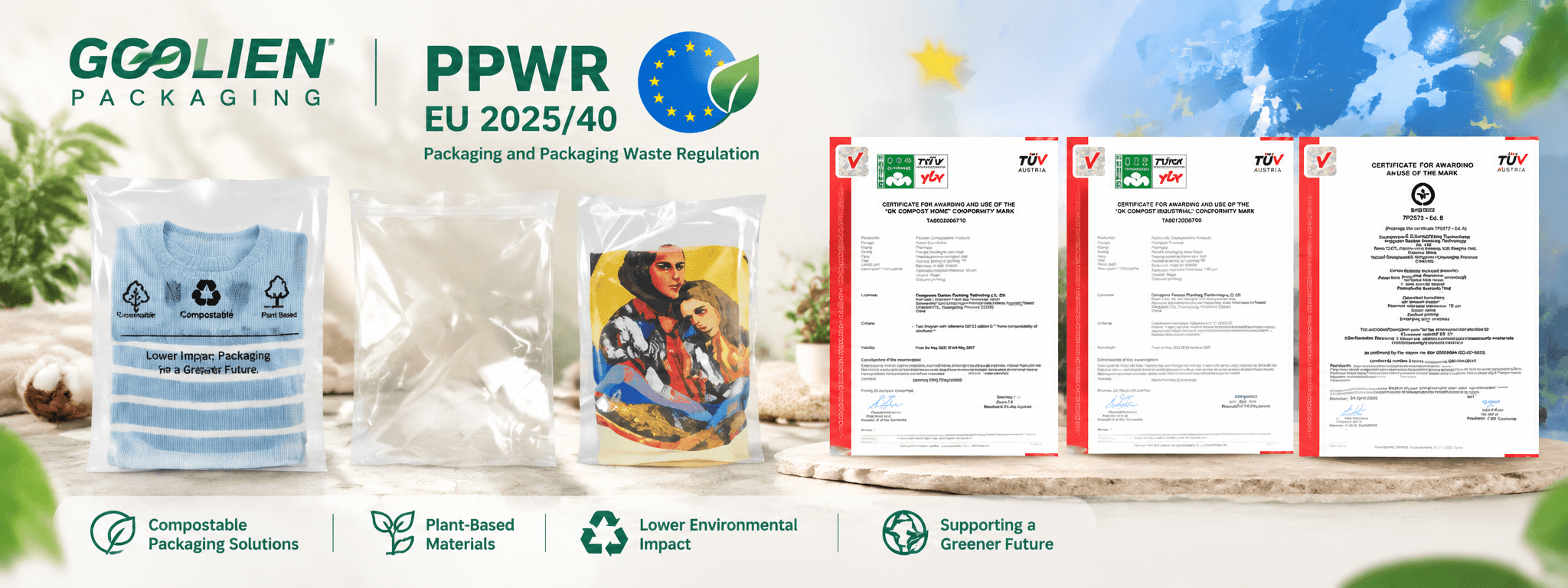
7. Why Choose Goolien Packaging?
Goolien Packaging provides customised flexible packaging solutions for apparel brands, including cellulose film bags, PE bags, PP/OPP bags, CPE bags, and other packaging options.
We support custom sizes and printing designs, helping customers select suitable materials and packaging structures according to their product requirements.
Our company has relevant certifications and management qualifications, including GRS, EN 15343, OK Compost Industrial, OK Compost Home, EN 13432, FSC, BSCI, SMETA, ISO 9001, and BPI.
These certifications and qualifications cover different materials, supply chain requirements, compostability standards, and management systems. Their applicability should be considered according to the relevant certification scope and product.
With experience in sustainable packaging materials, customised production, and packaging design, we help apparel brands develop practical packaging solutions that consider product protection, material requirements, and applicable market regulations.
Contact Goolien Packaging to discuss your packaging requirements and explore a customised solution for your brand.
References
Are Cellulose Film Bags Eco-Friendly and Compostable? Material Properties and Procurement Verification Guide