
Are Cellulose Film Bags Eco-Friendly and Compostable? Material Properties and Procurement Verification Guide
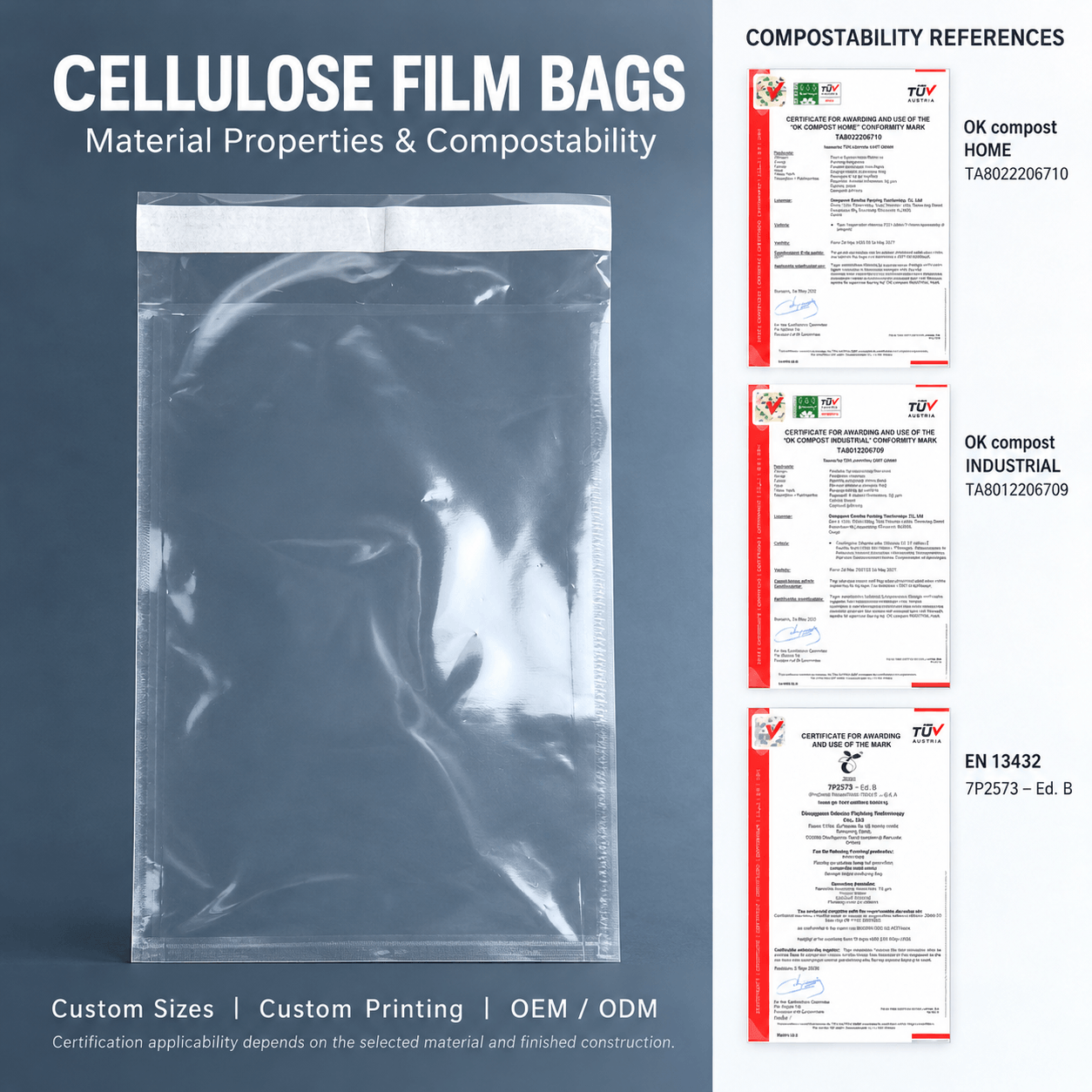
Can a clear, plant-derived packaging bag also be compostable?
Cellulose film bags can offer these benefits, but the answer depends on the film grade, finished-bag construction, and supporting evidence. Understanding these conditions helps buyers select packaging that meets both product protection and environmental requirements.
Key Questions About Cellulose Film Bags
- Are cellulose film bags eco-friendly?
They can offer renewable-material and product-display benefits. However, plant origin alone does not prove a lower overall environmental impact. Raw-material sourcing, production, packaging performance, and disposal options should also be considered.
- Can they be home or industrially compostable?
Some constructions can qualify for home compostability, industrial compostability, or both. Buyers should request evidence for the specific finished bag and claimed composting environment. Industrial compostability does not establish home compostability.
- Does a base-film certificate cover a printed bag?
Not automatically. Printing inks, coatings, adhesives, labels, and closure components must meet the applicable certification requirements. Check whether the evidence and permitted conversion conditions cover the bag being ordered.
- Are cellulose film bags moisture-resistant?
Performance varies with film grade and coating. Buyers should confirm the selected material’s properties rather than assume that cellulose film provides the same moisture protection as conventional plastic packaging.
Understanding the Material and Its Environmental Properties
Cellulose film, commonly called cellophane, is produced by regenerating plant-derived cellulose into a transparent film. Its clarity makes it useful for packaging that displays the product inside.
Cellulose film differs from glassine paper and PLA/PBAT film. These materials have different structures, appearances, and performance characteristics; their environmental claims should be assessed separately.
The European Commission’s policy framework distinguishes bio-based origin from biodegradability and compostability. A renewable feedstock does not automatically establish either disposal property.
The official OK compost INDUSTRIAL and OK compost HOME pages explain these different environments. Compostability assessment involves more than biodegradation alone: disintegration, compost quality, and relevant constituent limits also matter.
Certified compostability does not mean packaging can be discarded outdoors or placed in any recycling bin. Disposal instructions should match the certification and locally available collection and treatment options.
Four Steps to Verify a Purchase
Before bulk procurement, connect the environmental requirements with the approved sample and order specification.
1. Define the intended use and
environmental claim
Confirm the packed product, destination
market, storage conditions, and whether home or industrial compostability is
required.
2. Match documents to the finished
construction
Check the certificate issuer, holder,
number, validity, product scope, and permitted thickness. Review the film
grade, coatings, printing, adhesives, and closure against the supporting
documents. A test report should identify the tested specimen and conditions; it
should not be presented as a certification certificate.
3. Approve samples under realistic
conditions
Test product visibility, dimensions, print
adhesion, seal strength, closure operation, and performance after expected
storage and transport. Pay particular attention to moisture exposure and
handling requirements.
4. Lock the production specification
Retain the approved material specification,
artwork, dimensions, closure structure, evidence, and inspection criteria.
Review material or component changes before production.
Guanglian's Cellulose Film Packaging Manufacturing Capabilities
Dongguan Guanglian New Materials Co., Ltd. has 23 years of packaging industry experience, with 35 production lines and an overall factory capacity of approximately two million bags per day. Our integrated packaging manufacturing capabilities include film extrusion, up to eight-color printing, and bag making. For cellulose film projects, we convert selected films into custom packaging through printing, sealing, and finished-bag inspection.
Our packaging portfolio is supported by certifications relating to OK compost HOME, OK compost INDUSTRIAL, EN 13432, GRS, EN 15343, and FSC across different material categories. For cellulose film orders, the relevant compostability documents are matched to the selected material and finished construction; recycled-content and paper-sourcing certifications apply to their respective product ranges.
We manufacture custom cellulose film bags for apparel, footwear accessories, bags, home textiles, and consumer goods, supporting custom sizes and branded printing. Options include clear product presentation, self-adhesive closures, secure edge seals, and film-and-paper configurations according to project requirements. Our current cellulose film bags are not intended as moisture-barrier packaging.
By coordinating material selection, artwork, printing, bag conversion, and inspection, Guanglian supports OEM/ODM projects from sample approval through bulk production. Share your product dimensions, packaging structure, artwork, order quantity, destination market, and certification requirements so we can evaluate a suitable manufacturing specification.