
PPWR Recycled Content Evidence for Plastic Packaging
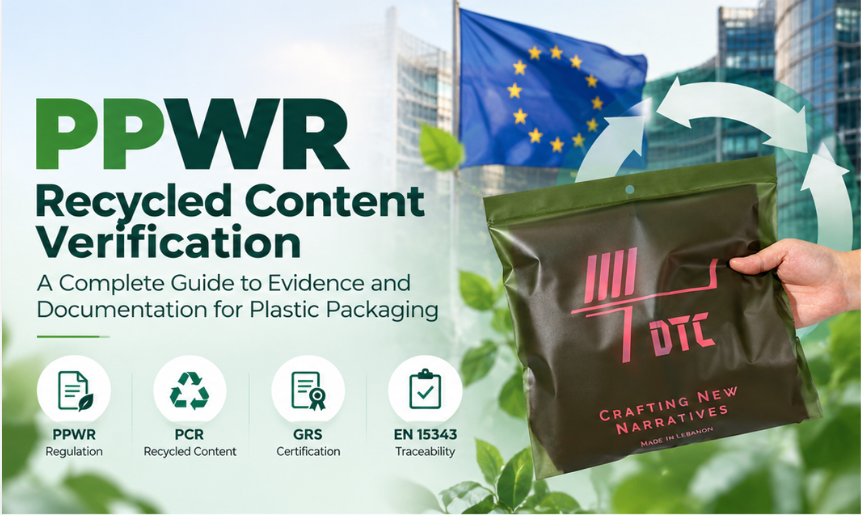
Verifying recycled content under the EU PPWR requires more than checking a certification label. For brands and packaging buyers, a structured review helps confirm material claims, supporting documentation, and supplier traceability. The following five steps provide a practical starting point for sourcing custom recycled plastic packaging.Step 1: Understand PPWR RequirementsIdentify applicable PCR targets and packaging categories.Step 2: Verify Recycled MaterialsConfirm PCR content and material specifications.Step 3: Check Supporting DocumentsReview GRS, EN 15343, TCs, and traceability records.Step 4: Verify Production TraceabilityConnect recycled materials with finished packaging.Step 5: Evaluate Packaging SuppliersAssess manufacturing capabilities and quality management.

PPWR Recycled Content Requirements: From Regulatory Rules to Practical Verification
The EU Packaging and Packaging Waste
Regulation (PPWR), Regulation (EU) 2025/40, introduces requirements addressing
packaging sustainability, material use, waste prevention, and circularity. For
brands sourcing custom recycled plastic packaging, understanding these
requirements is essential to making informed procurement decisions.
Using
recycled polyethylene (PE) is only the first step. Buyers must also determine
whether the recycled material qualifies as post-consumer recycled (PCR)
content, how the content is calculated, which documents support the claim, and
how those documents connect to the finished packaging.
GRS
certification, EN 15343-related traceability records, transaction certificates,
material specifications, supplier declarations, and production records can
contribute to an evidence system. However, no single voluntary certificate
automatically establishes PPWR compliance.
1. Understanding PPWR Recycled Content Requirements
Regulation (EU) 2025/40 generally began applying on 12 August 2026. However, Article 7 establishes a later implementation timetable for minimum recycled-content requirements in plastic packaging.
The first targets apply from 1 January 2030 or
three years after the relevant implementing act enters into force, whichever is
later.
For plastic packaging outside the specifically
identified contact-sensitive and beverage-bottle categories, Article 7 provides
the following minimum post-consumer recycled-content targets:
|
Target period |
Minimum PCR content |
|
2030, subject to the
applicable commencement rule |
35% |
|
2040 |
65% |
These percentages are not universal requirements
for every plastic packaging application. Packaging classification, exemptions,
calculation methodology, and other applicable conditions must be assessed.
For conventional non-contact-sensitive PE garment
bags, footwear packaging, and handbag packaging, the general plastic-packaging
category may be relevant. However, the applicable classification should always
be confirmed for the actual product and intended use.
Article 7 establishes an average calculation per
manufacturing plant and year, by packaging type and format. A PCR percentage
declared for a single bag, sample, or purchase order therefore does not
independently demonstrate compliance with the legal averaging requirement.
2. PCR vs. PIR: Which Recycled Materials
Count?
Post-Consumer Recycled Material (PCR)
PCR refers to recycled material recovered
from waste generated after products have been used by end users, including
households and commercial or institutional users.
PPWR Article 7 focuses on recycled content
recovered from post-consumer plastic waste, subject to applicable sourcing,
recycling, and verification conditions.
Post-Industrial Recycled Material (PIR)
PIR generally refers to eligible
pre-consumer manufacturing waste that is recovered and recycled before products
reach end users.
Although PIR can contribute to resource
efficiency, it should not automatically be counted toward PPWR's PCR-specific
minimum recycled-content targets.
For packaging procurement, buyers should
verify:
- Whether the recycled material is PCR, PIR, or a documented mixture.
- The declared recycled-content percentage and supporting calculation records.
- The resin grade and material specification.
- The origin and traceability of the recycled feedstock.
- Applicable certification scope and transaction documentation.
A general statement such as "made from
recycled plastic" is not sufficient to establish a specific PPWR
recycled-content claim.
3. How Is Recycled Content Calculated and Verified?
For procurement purposes, buyers should
understand the composition of the packaging they are purchasing.
A simplified product-level illustration is:
Illustrative PCR share (%) = PCR plastic
mass ÷ relevant total plastic mass × 100
For example, a hypothetical packaging structure
containing 40 kg of qualifying PCR plastic and 60 kg of other plastic material
within the selected boundary has an illustrative PCR share of 40%.
This example explains a material ratio
only. It is not the legally prescribed PPWR calculation methodology.
The actual regulatory assessment must
follow the applicable requirements for packaging type and format, manufacturing
plant, annual averaging, eligible recycled materials, and any relevant
exclusions.
Why Does the Calculation Boundary Matter?
Custom packaging may contain:
- PE film layers.
- Recycled and virgin resin blends.
- Zipper tracks and slider mechanisms.
- Adhesive strips and release liners.
- Printing inks, coatings, and labels.
- Transparent windows and multilayer structures.
These components may affect how the
relevant plastic material is identified and documented.
Buyers should request a complete bill of
materials and ask suppliers to explain which components are included in the
calculation and the basis for that treatment.
4. Which Documents Support Recycled Content Verification?
A reliable evidence system uses different
documents for different purposes.
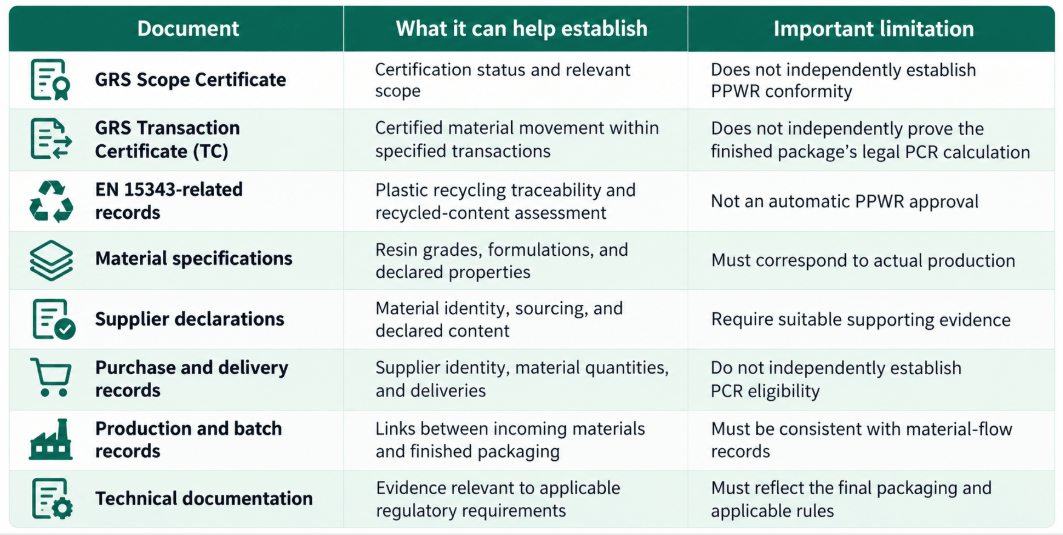
GRS Certification and Chain of Custody
The Global Recycled Standard (GRS),
administered by Textile Exchange, is a voluntary third-party certification
system covering recycled content, chain of custody, and specified processing
requirements.
Buyers should verify the certified legal
entity, certificate validity, material and process scope, and relevant
transaction documents.
A GRS logo or scope certificate alone does
not prove that every finished packaging order contains a particular PCR
percentage or complies with PPWR.
EN 15343 and Recycled Plastic Traceability
EN 15343 addresses plastics-recycling
traceability, conformity assessment, and recycled-content evaluation.
Related records can help establish how
recycled plastic is identified and traced through the supply chain.
However, EN 15343 documentation must still
be assessed against the PPWR requirements applicable to the finished packaging.
Transaction Certificates and Order-Level
Evidence
A transaction certificate can connect
certified materials to a particular transaction within the relevant
certification system.
Buyers should reconcile applicable TCs with
material descriptions, supplier identities, quantities, purchase orders,
delivery documents, and production records.
A TC should not be treated as a universal
PPWR compliance certificate.
Packaging Compliance Documentation
Packaging compliance documentation should
connect the applicable regulatory assessment with material specifications,
recycled-content evidence, supplier declarations, and relevant manufacturing
records.
For custom packaging, the documents should
identify the approved product structure and be sufficiently specific to support
the claims made about the finished packaging.
The exact documentation required depends on
the applicable PPWR provisions and implementing rules.
5. How to Verify Evidence for Custom Packaging Orders
A practical verification process should
connect the approved packaging specification to the materials purchased,
production records, and finished goods.
Example A: GRS Recycled PE Self-Adhesive
Garment Bags
A European apparel brand orders customized
PE self-adhesive bags with a specified PCR target, printed branding, and
adhesive closure.
The buyer should confirm the film
structure, thickness, dimensions, printing, and closure specifications. The
requested PCR percentage and its calculation basis should be identified before
production.
Relevant supplier certification and
recycled-resin documentation should then be reviewed, with incoming resin lots
connected to the production order and finished-bag batches.
Any material or adhesive changes should be
reviewed before repeat production.
This process helps distinguish a declared
recycled-content specification from the evidence supporting the actual
delivered product.
Example B: Recycled Packaging for Footwear
and Handbag Brands
Footwear and handbag packaging may require
larger bag dimensions, specific material strength, custom printing, or
resealable closures.
Where GRS recycled-content PE packaging is
specified, buyers should review not only the recycled film but also the
relevant closure materials, additional components, and approved product
construction.
For printed packaging, material
specifications and production records should correspond to the approved
artwork, film structure, and manufacturing order.
Where several bag sizes or formats are
purchased, the documentation should clearly identify which specifications and
finished-product batches are covered.
Example C: Custom PE/PE Flexible Packaging
For custom PE/PE flexible packaging, buyers
should review the recycled-content evidence alongside the complete film
structure, lamination materials, printing specifications, and production
records.
The description “PE/PE” does not
independently establish PCR content, material traceability, recyclability, or
PPWR conformity.
Any recycled-content claim should
correspond to the actual approved formulation and applicable evidence.
Why Repeat Orders Require Continued
Verification
A sample approved for appearance,
dimensions, and sealing performance does not automatically demonstrate that
later orders use identical recycled-material sources or formulations.
Repeat orders should include appropriate document reconciliation and change control for resin suppliers, recycled-content targets, formulations, manufacturing sites, and relevant subcontracting arrangements.
6. Why Manufacturing Capability Matters for
Recycled Packaging
Recycled-content documentation is
important, but reliable manufacturing is equally relevant to packaging procurement.
Apparel, footwear, and handbag brands need
packaging that combines documented material specifications with practical
performance.
Key requirements include consistent film
thickness and bag dimensions, reliable seals and closure performance, clear custom
printing, suitable strength and protection, and repeatable quality across bulk
production orders.
When recycled materials are used, material
selection and production parameters must be coordinated with the intended bag
structure and performance requirements.
Integrated manufacturing capabilities can
support communication between film production, printing, bag conversion, and
quality control.
7. Goolien's Recycled Packaging,
Certifications, and Manufacturing Capabilities
Goolien is a direct packaging manufacturer
with 23 years of experience, providing customized sustainable packaging
solutions for international brands, packaging buyers, and supply-chain
partners.
Integrated Manufacturing Capabilities
Our manufacturing capabilities include:
- 35 production lines supporting large-scale custom packaging production.
- Approximately 2 million bags of daily production capacity, depending on product specifications and production arrangements.
- Integrated film blowing, up to eight-color printing, and bag making for coordinated production.
- OEM/ODM customization, including material selection, sizes, printing, designs, and bag structures.
Custom Recycled Packaging for Apparel,
Footwear, and Accessories
Goolien's product range includes:
- GRS recycled-content PE mailing bags.
- Custom recycled PE self-adhesive garment bags.
- Recycled-content zipper and resealable bags.
- Custom PE/PE flexible packaging.
- Other customized packaging formats for apparel, footwear, handbags, and retail applications.
Different packaging structures may require
different material formulations, performance specifications, and supporting
documents.
For this reason, recycled-content
requirements should be confirmed for each approved product specification rather
than assumed across the entire product range.
Recycled Material Certification and
Traceability
Goolien's existing certification references
include:
- GRS Certificate: ETK-00043579-GRS-2605
- EN 15343 / SGS Reference: CN24/00007439
- GRS Transaction Certificates: Available for eligible transactions within the applicable certification scope and procedures.
These references provide starting points
for verification. Buyers should confirm current validity, certified legal
entities, scope, and relevance to the specific material or transaction.
These credentials support recycled-material
sourcing and traceability discussions but should not be interpreted as
automatic proof of PPWR compliance for every product.
Quality Management and Social Compliance
Beyond recycled-material documentation,
Goolien maintains ISO 9001 quality management certification and participates in
BSCI and SMETA social compliance assessments.
ISO 9001 relates to quality management
processes, while BSCI and SMETA address aspects of supplier social
responsibility and workplace practices.
These systems and assessments support
manufacturing and supplier-management discussions. They do not independently
establish PCR content or PPWR conformity.
Together with our integrated production
capabilities, they provide additional information for international buyers
evaluating a packaging manufacturing partner.
From Custom Specifications to Bulk
Production
Goolien supports customers through material
selection, packaging structure development, custom printing, and bulk
manufacturing.
Our integrated production capabilities help
coordinate the transition from approved packaging specifications to finished
products.
For buyers requesting recycled-content
documentation, the relevant material and certification requirements should be
identified during product development and confirmed against the documentation
available for the specific order.
8. Pre-Production Checklist for European
Packaging Buyers
Before approving custom recycled-content
packaging, buyers should review:
- Regulatory applicability: Identify the relevant PPWR provisions, packaging category, and any exemptions.
- Material identity: Confirm whether the recycled input is PCR, PIR, or a documented mixture.
- Recycled-content evidence: Review declared percentages and the supporting material-accounting records.
- Certification scope: Verify the certified entity, material, process, site, and validity where relevant.
- Transaction traceability: Reconcile applicable transaction documents with purchase and delivery records.
- Production traceability: Connect incoming material lots to production orders and finished packaging batches.
- Product performance: Approve dimensions, thickness, printing, strength, and closure requirements.
- Change control: Review changes in resin source, formulation, manufacturing site, or relevant subcontracting.
- Regulatory documentation: Confirm that applicable technical-documentation and verification requirements have been addressed.
These checks can support supplier qualification,
product development, and repeat-order management.
9. Frequently Asked Questions
Is a GRS Certificate Enough to Prove PPWR
Compliance?
No. GRS can support specified
recycled-content and chain-of-custody claims, but PPWR compliance requires a
separate assessment of the applicable legal requirements and supporting
evidence.
What Is the Difference Between PCR and PIR?
PCR comes from post-consumer waste, while
PIR generally comes from eligible pre-consumer manufacturing waste. PPWR
Article 7 focuses on recycled content recovered from post-consumer plastic
waste.
Does a GRS Transaction Certificate Prove
the Recycled Content of a Finished Bag?
Not independently. A TC provides
transaction-level evidence within the certification system. Finished-product
claims require appropriate connections to actual material inputs and
manufacturing records.
Does PE/PE Packaging Automatically Comply
With PPWR?
No. PE/PE describes the main polymer
structure. It does not independently prove PCR content, traceability,
recyclability, or overall PPWR conformity.
Do All Plastic Bags Have the Same
Recycled-Content Requirement?
No. PPWR distinguishes packaging categories
and includes exemptions and specific conditions. Requirements must be
determined for the actual packaging.
Why Should Repeat Orders Be Reviewed?
Because recycled-resin sources,
formulations, material lots, and manufacturing arrangements may change.
Document reconciliation and change control help maintain consistency between
approved specifications and delivered products.
10. Related Topics for Packaging Buyers
For a more detailed understanding of
recycled-content verification, explore these related topics:
- PCR vs. PIR: What Counts Toward PPWR Recycled Content?
- How to Verify a GRS Certificate and Transaction Certificate
- EN 15343 and Recycled Plastic Traceability
- Recycled Packaging Procurement Checklist for Apparel Brands
- How Packaging Components Affect Mono-Material Recyclability
These topics can help buyers understand the
relationship between recycled-material sourcing, documentation, packaging
design, and procurement decisions.
11. Conclusion: Building Reliable Recycled
Packaging Evidence
PPWR recycled-content verification requires
more than collecting certificates.
For apparel, footwear, handbag, and retail
packaging, buyers should understand the relevant legal requirements, identify
qualifying PCR materials, review supporting documentation, and maintain
traceable connections between recycled inputs and finished packaging.
GRS certification, EN 15343-related
records, transaction certificates, material specifications, and manufacturing
records can each support this process, but they serve different purposes.
With in-house manufacturing, recycled
packaging experience, quality-management practices, and OEM/ODM capabilities,
Goolien supports brands seeking customized packaging solutions with clearly
defined material, printing, structural, and production requirements.
Looking for custom GRS recycled-content
packaging for your brand?
Contact Goolien to discuss
recycled-material options, PCR targets, packaging structures, custom printing,
and the documentation available for your specific order.
Website: https://www.goolien.com/