
How Zippers, Adhesive Strips, Labels, and Windows Affect Mono-Material Packaging Recyclability

A mono-material pouch is not automatically recyclable. The complete package—including its zipper, adhesive, label, window, inks, coatings and barriers—must remain compatible with the intended collection, sorting and recycling pathway. Buyers should evaluate the finished configuration against target-market criteria and distinguish recycled-content certification from recyclability evidence.
For apparel brands, retailers, and packaging buyers, evaluating recyclable flexible packaging requires reviewing the complete structure rather than relying on the main film material alone. Recycled-content certification must also be distinguished from evidence supporting the recyclability of the finished package.
Key considerations include:
Select closures, windows, and labels that are compatible with the intended base-film recycling stream.
Assess adhesive formulations and their behavior during recycling, not simply their proportion by weight.
Verify destination-market recycling conditions, component specifications, and supporting technical evidence.
Distinguish GRS recycled-content certification from finished-package recyclability assessments.
How to Evaluate Mono-Material Packaging Recyclability
Define the destination market and recycling stream
Identify where the finished packaging will be sold and determine whether an appropriate flexible PE collection, sorting, and recycling pathway is available.
A packaging structure designed for PE recycling may meet technical compatibility criteria without being widely collected in every destination market. Therefore, technical recyclability and local recycling availability should be assessed separately.
Review every package component
Document the polymer composition, material weight, coverage, color, and attachment method of the main film and all additional components.
For zipper packaging, distinguish between press-to-close profiles, zipper tracks, and slider mechanisms, as these may contain different material formulations.
For self-adhesive packaging, evaluate the adhesive remaining on the bag separately from any release liner removed before disposal.
Transparent windows should also be classified according to whether they form part of the original film structure or are attached as separate materials.
Compare the design with recognized guidance
Evaluate the complete packaging structure against the relevant design-for-recycling guidelines for the intended material stream.
Component compatibility should be assessed according to the applicable guideline version, material composition, and testing requirements.
Where published guidance does not clearly address a particular combination of films, closures, adhesives, or other components, additional technical assessment or testing may be necessary.
Approve evidence for the final configuration
Request technical specifications, a complete bill of materials, applicable certification documents, artwork, and relevant recyclability assessment or testing reports.
Ensure that the evidence corresponds to the actual finished packaging structure.
Changes to film grades, closure materials, adhesives, labels, or window construction after sample approval should trigger a review of the original assessment before bulk production.
Common Questions About Packaging Components
No. A compatible PE zipper can support material consistency, but the zipper track, slider mechanism, main film, and other components must still be evaluated together.
The finished package must also be suitable for the intended recycling process and relevant market conditions.
Does a Transparent Window Prevent Recycling?
Not necessarily. A transparent section integrated into a compatible PE-based film structure may support material consistency.
However, a separately inserted window can introduce additional polymers or bonding materials that require further assessment.
The recyclability of the complete structure cannot be determined from the window's appearance alone.
Does GRS Certification Prove Recyclability?
No. GRS addresses recycled content, chain of custody, and specified processing requirements within its certification scope.
It does not independently demonstrate that a finished packaging product is recyclable.
A separate assessment of the packaging structure and relevant recycling pathway is required to substantiate recyclability claims.
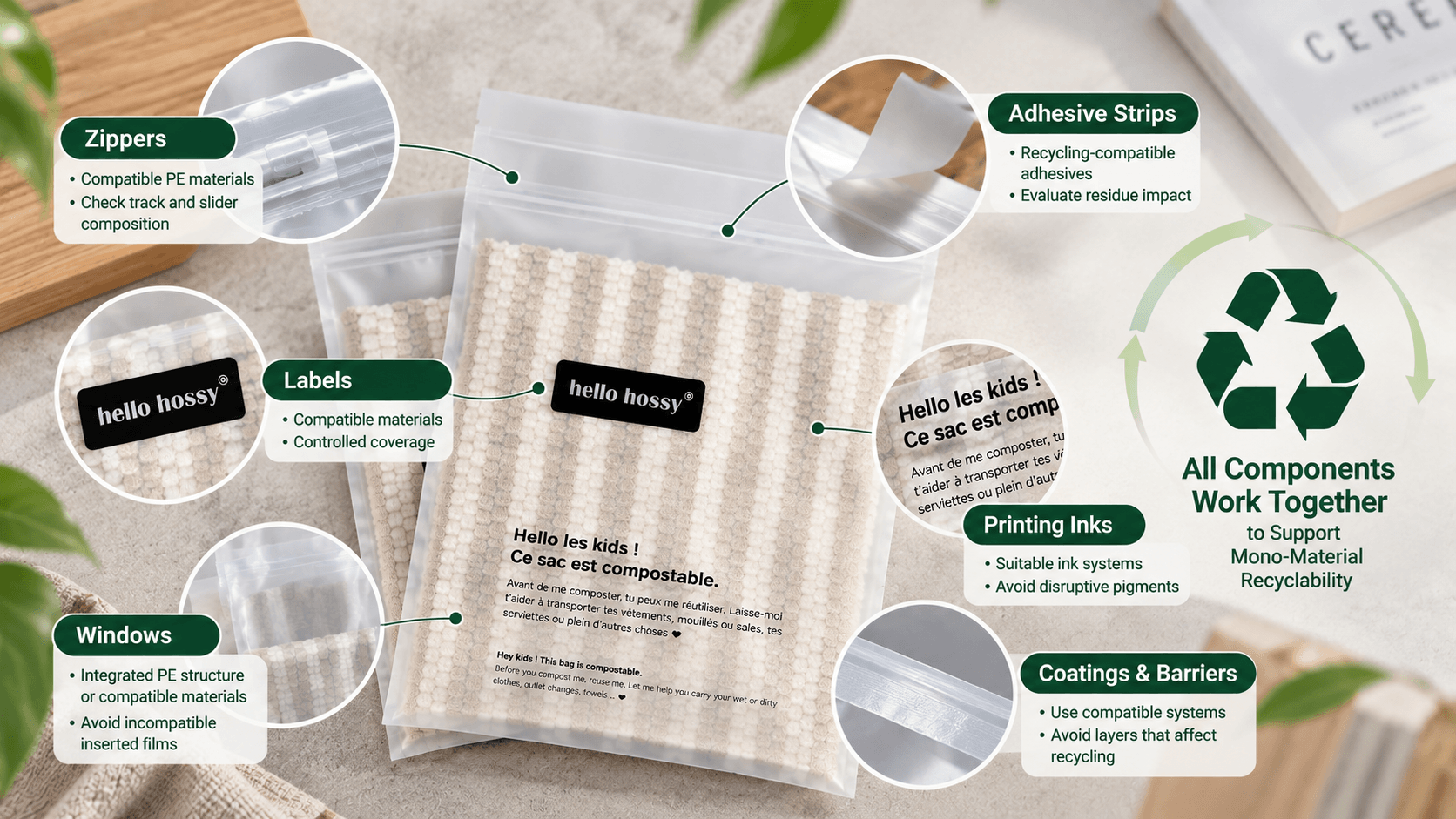
Packaging Component Compatibility Matrix
The following table summarizes general design considerations for PE-based flexible packaging.
| Component | General Design Considerations | Potential Recycling Risks |
|---|---|---|
| Zippers and closures | Use materials compatible with the main PE film; assess slider components separately | Incompatible polymers or closure materials |
| Adhesive strips | Select suitable adhesive formulations and evaluate residues during recycling | Persistent residues or processing interference |
| Labels | Consider substrate compatibility, adhesive chemistry, and label coverage | Incompatible substrates, excessive coverage, or problematic adhesives |
| Transparent windows | Prefer compatible PE-based construction where technically suitable | Incompatible inserted films or bonding materials |
| Printing inks | Evaluate ink chemistry, pigments, and print coverage | Disruptive pigments, inks, or processing residues |
| Coatings and barriers | Select systems compatible with the intended recycling process | Incompatible barrier layers or coatings affecting recyclate quality |
These recommendations describe general design directions, not automatic recyclability approvals. Specific structures should be evaluated against the applicable technical criteria.
Recycling Guidelines and Market-Specific Requirements
The CEFLEX Designing for a Circular Economy Guidelines provide guidance for flexible packaging design, including material selection, attachments, adhesives, printing inks, and barrier technologies.
For PE/PE packaging, these principles support evaluating the entire packaging structure rather than assuming that a mono-material description guarantees recyclability.
The RecyClass Design for Recycling Guidelines provide polymer- and stream-specific compatibility guidance and assessment methods. Packaging buyers should consult the relevant current guidance for their particular material and structure.
For the United States, the Association of Plastic Recyclers Design Guide offers technical information on how packaging features can influence sorting and reprocessing.
These frameworks help inform packaging design decisions, but technical compatibility should not be confused with the availability of local collection and recycling infrastructure.
Recycled-Content Claims and Procurement Verificatio
Textile Exchange's Global Recycled Standard addresses recycled-content verification, chain of custody, and specified processing requirements.
However, a GRS-certified recycled-content material does not automatically make the finished packaging recyclable.
When sourcing GRS recycled PE packaging, buyers should verify the supplier's relevant certification scope and applicable transaction documentation, as well as obtain separate evidence supporting any recyclability claims.
For the US market, the FTC Green Guides provide guidance on environmental marketing claims, including qualifications that may be necessary when recycling facilities are not available to a substantial majority of consumers or communities.
Environmental claims should therefore reflect both the packaging's technical characteristics and the relevant destination-market conditions.
Pre-Production Checklist for Packaging Buyers
Before approving customized PE/PE packaging, zipper bags, self-adhesive bags, or GRS recycled-content packaging, buyers should:
Confirm the complete PE/PE film structure, including any adhesives, coatings, and non-PE barrier materials.
Verify zipper tracks, slider materials, adhesive formulations, label construction, window materials, and printing specifications.
Request technical data sheets, a bill of materials, relevant certification documents, and available configuration-specific recyclability evidence.
Check the applicable recycling guidelines and environmental claim requirements for the destination market.
Approve samples for functional performance, appearance, and relevant recycling design criteria.
Review any material or structural changes after sample approval to ensure consistency with the evaluated configuration.
These steps help brands manage packaging specifications, reduce the risk of unsupported environmental claims, and maintain consistency between approved samples and bulk production.
Custom Flexible Packaging Development with Goolien
As a direct packaging manufacturer with 23 years of experience, Goolien combines in-house film blowing, printing, bag making, and OEM/ODM capabilities to provide customized packaging solutions for international brands and supply chain partners.
Our product range includes GRS recycled-content packaging, PE/PE flexible packaging, slider zipper bags, self-adhesive bags, and packaging with transparent window designs.
We support custom material selection, bag structures, sizes, and printing requirements, helping apparel, retail, and consumer goods brands develop packaging suited to their functional and market needs.
By considering material compatibility and packaging components during product development, brands can make more informed decisions about packaging performance and recycling-oriented design.
Final recyclability claims should always be based on the approved packaging specification, supporting technical evidence, and destination-market recycling conditions.
Explore Goolien's custom sustainable packaging solutions: www.goolien.com