How to Choose a Reliable Packaging Supplier for Apparel Brands Exporting to the EU

How to Choose a Reliable Packaging Supplier for Apparel Brands Exporting to the EU
For apparel, footwear, and luggage brands entering the European Union market, choosing a packaging supplier is no longer simply a matter of comparing prices, materials, and delivery times.
Buyers must also consider regulatory responsibilities, recycled-content evidence, packaging recyclability, product protection, and manufacturing consistency.
A reliable supplier should be able to provide suitable packaging solutions, explain material specifications, support relevant documentation, and maintain consistent quality from sampling to bulk production.
This guide explains the key requirements and provides a practical framework for evaluating packaging manufacturers serving the EU apparel market.
1. Frequently Asked Questions About EU Apparel Packaging Suppliers
Q1. What should apparel brands prioritize when choosing a packaging supplier?
Buyers should evaluate five essential factors:
- Regulatory awareness: Understanding of relevant EU packaging requirements.
- Material suitability: Packaging that protects products and meets the intended application.
- Documentation: Verifiable material specifications, certifications, and supporting records.
- Customization: Ability to manufacture the required sizes, printing, and bag structures.
- Manufacturing reliability: Consistent quality, confirmed lead times, and dependable order fulfillment.
A supplier should be assessed on its ability to meet the complete packaging specification, not simply its ability to offer an environmentally marketed material.
Q2. Does every packaging supplier need GRS certification to sell packaging into the EU?
No. GRS is a voluntary recycled-material certification standard, not a universal legal requirement for packaging sold in the EU.
GRS helps verify recycled material claims and traceability within a certified supply chain. However, it does not independently demonstrate packaging recyclability or compliance with all requirements of the EU Packaging and Packaging Waste Regulation (PPWR).
Buyers should first identify the applicable legal obligations, then determine which certificates, test reports, and supporting documents are needed.
Q3. What is the difference between PCR and PIR recycled materials?
Post-Consumer Recycled (PCR) material comes from products that have completed their intended use and entered the waste stream.
Pre-Consumer Recycled (PIR) material generally comes from manufacturing waste diverted from the waste stream, excluding material that can be reclaimed within the same process that generated it.
Both may be recognized under recycled-material certification systems, subject to their definitions and requirements.
However, the recycled-content obligations under PPWR Article 7 specifically refer to recycled content recovered from post-consumer plastic waste.
Therefore, buyers should not assume that a general recycled-content percentage automatically satisfies a PCR-specific regulatory requirement.
Q4. Does recyclable packaging mean it contains recycled material?
No. Recyclability and recycled content describe different characteristics.
- Recycled content refers to the proportion of recycled material used to manufacture packaging.
- Recyclability concerns whether the finished packaging can be effectively collected, sorted, and recycled under applicable requirements.
- Compostability concerns whether packaging meets specified biodegradation and disintegration requirements under defined composting conditions.
For example, a PE garment bag may contain recycled material without automatically meeting all recyclability requirements. Conversely, a recyclable packaging design may be manufactured using virgin material.
Each claim requires appropriate evidence.
Q5. How can buyers verify a packaging supplier's manufacturing reliability?
Buyers should examine the complete production process, from material selection and sampling to printing, bag making, inspection, and delivery.
Important checks include dimensional accuracy, film thickness, printing consistency, sealing strength, product protection, and repeat-order quality.
Before bulk production, buyers should approve representative samples and establish clear acceptance criteria.
A reliable supplier should also explain how material changes, production deviations, and delivery issues are communicated and managed.
2. Understanding EU Packaging Requirements Before Supplier Selection
2.1 What Does PPWR Mean for Apparel Packaging?
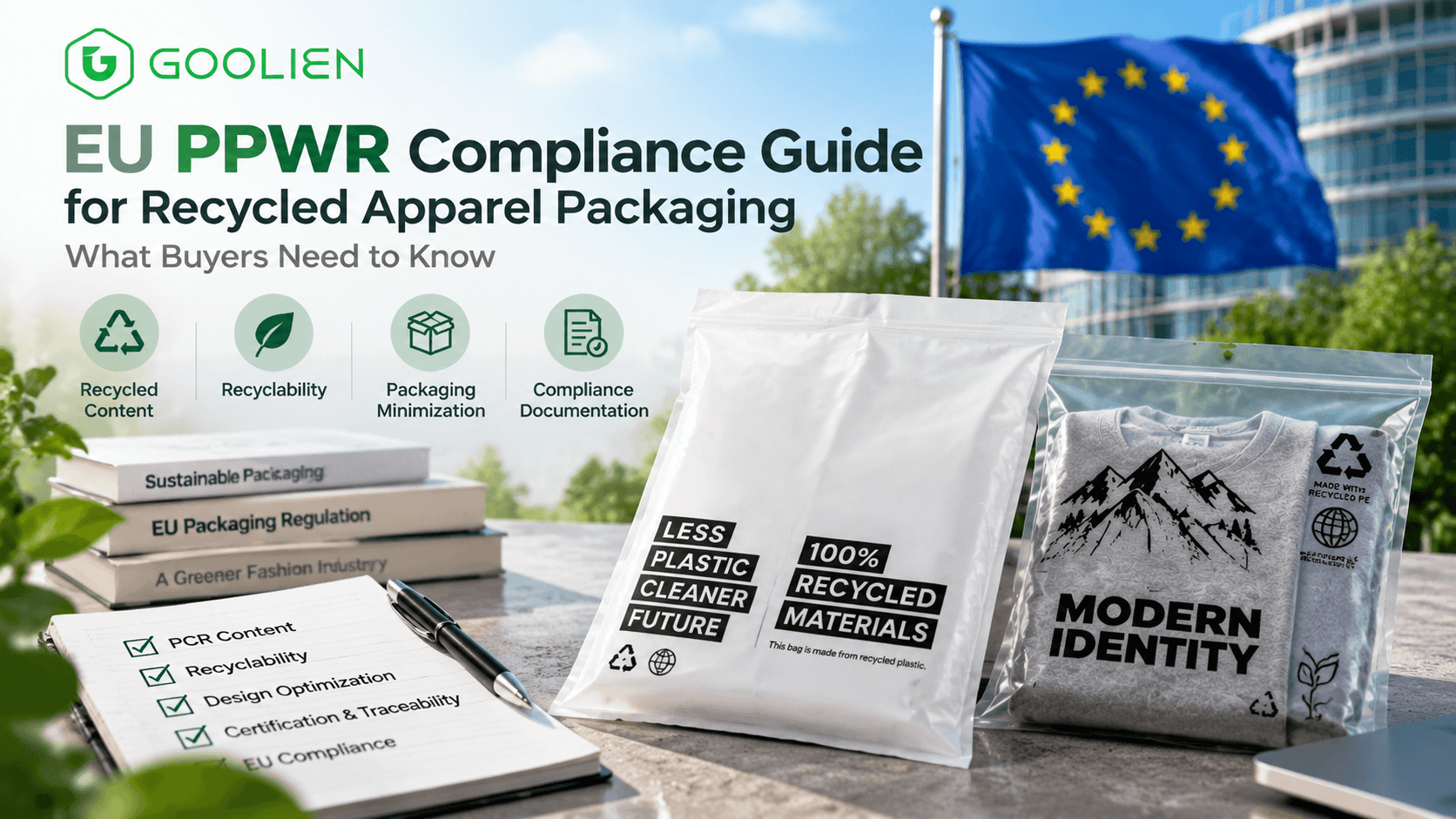
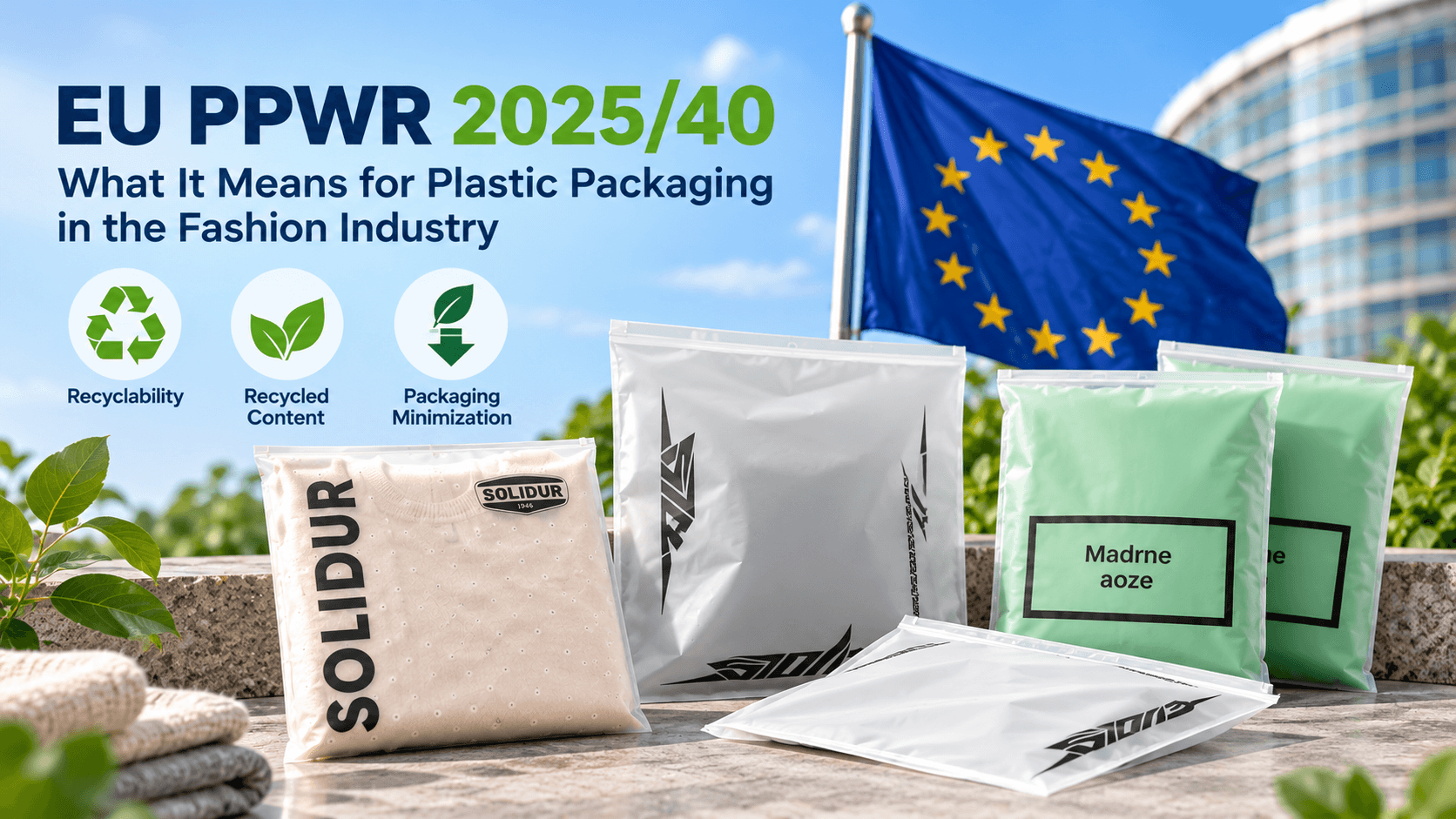
Regulation (EU) 2025/40, known as the Packaging and Packaging Waste Regulation (PPWR), establishes a harmonized framework for packaging placed on the EU market.
The regulation entered into force on 11 February 2025 and generally began applying on 12 August 2026. However, individual requirements have different implementation dates.
For apparel packaging procurement, important topics include:
Packaging Recyclability
PPWR establishes requirements for packaging to be designed for recycling. The application of detailed recyclability criteria is phased, with important requirements beginning in 2030 or later, depending on the relevant implementing measures.
Recycled Content in Plastic Packaging
Article 7 establishes future minimum post-consumer recycled-content requirements for applicable plastic packaging categories, subject to exemptions and implementation rules.
For example, the regulation sets a 35% minimum for certain plastic packaging outside the specified contact-sensitive and beverage-bottle categories, beginning in 2030 or a later date determined by the applicable implementation timetable.
This figure should not be applied automatically to every garment bag without first confirming the correct packaging classification, exemptions, and calculation requirements.
Packaging Minimization
Packaging should be designed to avoid unnecessary weight and volume while maintaining its required functionality and product protection.
Technical Documentation
Relevant economic operators must be able to demonstrate conformity with applicable requirements using appropriate technical documentation and conformity assessment procedures.
Procurement implication: Buyers should evaluate the complete packaging design and its supporting evidence rather than relying on a single certificate or environmental label.
2.2 What Documents Should Buyers Request?
Different documents answer different questions.
| Document | What It Helps Verify | Important Limitation |
|---|---|---|
| GRS Scope Certificate (SC) | Certified organization, product scope, and eligible activities | Does not prove that every order is certified |
| Transaction Certificate (TC) | Certification status and traceability of specified transactions | Must correspond to the actual transaction and products |
| EN 15343-related evidence | Recycled-plastic traceability and recycled-content assessment | Does not independently prove PPWR compliance |
| Material Specification | Resin type, thickness, composition, and technical properties | Must match the approved finished packaging |
| Test Report | Performance or characteristics under specified test conditions | Applies only within the tested scope |
| ISO 9001 | Certified quality management system | Does not certify an individual packaging product |
| BSCI / SMETA Assessment | Relevant social compliance information | Does not establish product environmental compliance |
Before approving documentation, buyers should check the issuer, certificate number, validity period, covered company, manufacturing site, material scope, and product description.
For recycled-material orders, the distinction between a Scope Certificate and a Transaction Certificate is particularly important: the former concerns certification scope, while the latter concerns specified certified transactions.
2.3 Who Is Responsible for EU Packaging Compliance?
A packaging supplier can provide technical information and supporting evidence, but the responsibilities of manufacturers, importers, and other economic operators depend on their roles under the applicable legislation.
A brand or importer should not assume that purchasing from a certified supplier automatically transfers all regulatory responsibility to that supplier.
Before placing an order, buyers should clarify:
- Who provides the material composition and technical specifications?
- Who prepares or supplies the relevant test evidence?
- Who is responsible for the applicable conformity assessment and documentation?
- How will changes in material, printing, or packaging structure be reviewed?
Clear responsibility allocation reduces documentation gaps and procurement risks.
3. How to Evaluate Packaging Materials and Manufacturing Capabilities
Step 1: Match the Material to the Packaging Application
Material selection should begin with the actual product and distribution requirements.
| Material | Typical Advantages | Points to Evaluate |
|---|---|---|
| PE | Flexible, protective, suitable for garment bags and mailers | Recycled content, thickness, closure components, recyclability evidence |
| CPE | Soft, frosted, semi-transparent appearance | Visibility, printing, material composition, recycling compatibility |
| OPP / PP | Clear product presentation and various packaging structures | Film structure, seals, additional components |
| PLA + PBAT | Compostable packaging options for suitable applications | Finished-packaging evidence, composting conditions, local disposal routes |
| Glassine Paper | Paper-based, semi-transparent presentation | Tear resistance, moisture exposure, coatings, adhesives, paper-stream compatibility |
There is no universally suitable material for every apparel product.
For example, transparent display packaging, protective shipping mailers, and premium accessory packaging may require different structures and performance characteristics.
Step 2: Evaluate the Complete Packaging Structure
A material's environmental properties do not automatically describe the performance of the finished bag.
Buyers should examine the entire packaging structure, including:
- Main film or paper substrate
- Zippers, sliders, and self-seal closures
- Printing inks and coatings
- Adhesives, labels, and transparent windows
- Material thickness and total packaging weight
These components may influence recyclability, product protection, and material compatibility.
For packaging intended to be recyclable, buyers should request evidence relevant to the finished design and applicable assessment criteria.
Step 3: Verify Customization and Sampling
A capable OEM/ODM manufacturer should be able to confirm:
- Custom bag dimensions and thickness
- Suitable bag structures and closure options
- Printing artwork and color requirements
- Material and structural limitations
- Sample approval and production specifications
Sampling should verify both appearance and functionality.
For example, an apparel zipper bag may require checks for opening and closing performance, sealing quality, film strength, printing alignment, and product fit.
The approved sample should become a reference for bulk production.
Step 4: Assess Factory Quality Control
Manufacturing evaluation should cover the complete workflow:
Raw Material Inspection → Printing → Bag Making → Finished Product Inspection → Packing
Buyers should ask how the factory monitors dimensions, thickness, printing defects, sealing quality, and production consistency.
It is also important to establish acceptable tolerances and inspection methods before production.
Step 5: Confirm Commercial and Delivery Conditions
Before issuing a purchase order, confirm the minimum order quantity, unit price, printing plate charges, sample costs, production lead time, packing requirements, and delivery terms.
For repeat orders, clarify whether approved materials, artwork, and production specifications will remain unchanged.
Any material substitution or structural modification should require appropriate review and approval.
4. Practical Supplier Evaluation Checklist
Use the following checklist before approving a packaging manufacturer.
| Evaluation Area | Buyer Verification |
|---|---|
| Regulatory Requirements | Identify applicable EU obligations and implementation dates |
| Material Selection | Confirm composition, application, and performance |
| Recycled Content | Distinguish PCR from PIR and verify supporting evidence |
| Environmental Claims | Check recycled-content, recyclability, and compostability claims separately |
| Certifications | Verify issuer, validity, scope, and transaction relevance |
| Packaging Design | Review closures, printing, adhesives, and other components |
| Customization | Confirm dimensions, thickness, structure, and artwork |
| Sampling | Approve representative samples and acceptance criteria |
| Quality Control | Review inspection procedures and production consistency |
| Order Fulfillment | Confirm MOQ, pricing, lead time, and delivery arrangements |
| Change Management | Require approval for relevant material or specification changes |
Final procurement recommendation: Select a supplier based on verifiable technical capabilities, appropriate documentation, packaging performance, and reliable production—not price or certification logos alone.
5. Custom Packaging Solutions from Goolien
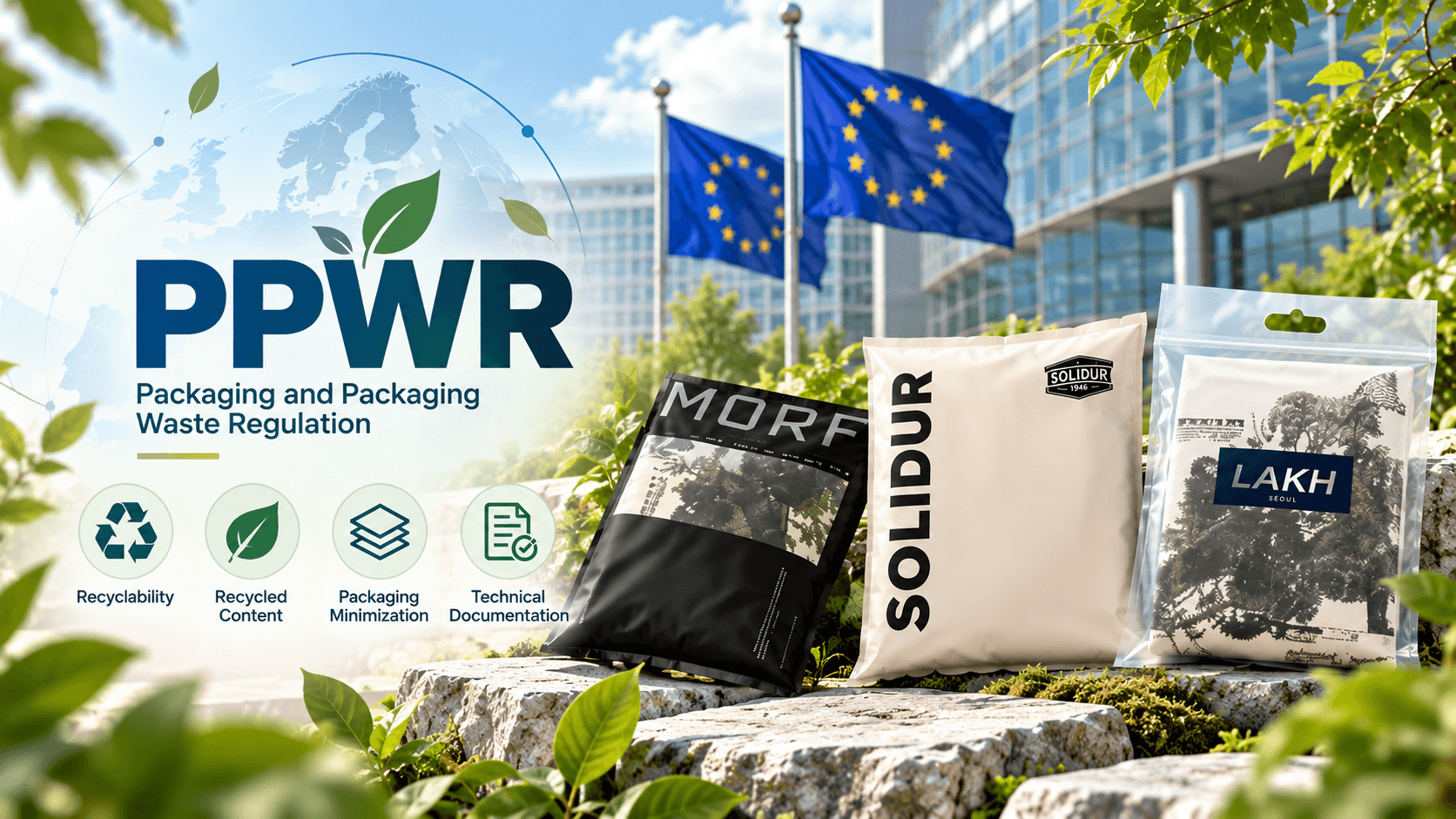
Goolien specializes in customized flexible packaging for apparel, footwear, luggage, and consumer product brands, with manufacturing operations in China and Cambodia.
Our capabilities include:
- Multiple Material Options: Recycled PE, CPE, OPP, PP, PLA + PBAT, Glassine paper, and cellulose film packaging solutions.
- Certification and Documentation Support: GRS, EN 15343, OK Compost, FSC, ISO 9001, BSCI, and SMETA-related capabilities, subject to applicable scope and document availability.
- OEM/ODM Customization: Custom sizes, printing, thicknesses, and bag structures, including self-seal bags, grip-seal bags, zipper bags, slider zipper bags, and shipping mailers.
- Manufacturing Support: Sampling, printing, bag making, quality inspection, and bulk order fulfillment.
We help international buyers evaluate material options and develop custom packaging according to their product and purchasing requirements.
Looking for a custom packaging manufacturer?
Contact Goolien with your preferred material, bag dimensions, thickness, printing artwork, and estimated order quantity to discuss suitable packaging solutions and request a quotation.
Official References
- Regulation (EU) 2025/40 — Packaging and Packaging Waste Regulation
- European Commission — Packaging and Packaging Waste
- European Commission — PPWR Implementation Guidance
- Textile Exchange — Recycled Claim Standard and Global Recycled Standard
- Textile Exchange — Standards FAQs
- https://www.goolien.com/
EU PPWR Compliance Guide for Recycled Apparel Packaging: What Buyers Need to Know
EU PPWR 2026: A Practical Compliance and Procurement Guide for Apparel, Footwear & Luggage Packaging