
Garment Packaging Bag Specification Guide: Dimensions, Thickness, and Transport Compatibility
What size and thickness should a garment packaging bag be? Can zipper bags and mailers use the same specifications?
The right specification depends on the product’s
folded dimensions, weight, bag construction, and shipping method. A bag must
provide sufficient packing space while meeting closure, presentation, and
protection requirements. Selecting thickness by weight alone can overlook risks
from hardware, sharp corners, and transport abrasion.
Common Questions About Bag Specifications
Is a bag slightly larger than the folded garment sufficient?
Not always. Product thickness also takes up bag
space, while zippers, seals, and adhesive flaps affect the usable packing area.
Confirm how the supplier defines dimensions, then verify fit with the actual
product.
Does a thicker bag always provide better
protection?
Additional thickness may improve certain
properties, but material formulation, seal quality, closure construction, and
product shape also matter. Different materials at the same thickness should not
be assumed to offer equal load-bearing capacity or puncture resistance.
Can an inner packaging bag be used directly as a
mailer?
Suitability must be verified. Inner bags primarily support presentation, individual packing, and protection within an outer carton. Direct parcel delivery also requires assessment of abrasion, impact, moisture exposure, snagging, and closure reliability. Test the complete packed configuration.
How to Match Dimensions, Thickness, and Bag Construction
Step 1: Measure the Product as It Will Be Packed
Using the actual folding or stacking
method, record the product’s length, width, maximum thickness, weight, and
quantity per bag. For products with zipper pulls, buckles, or other hardware,
include protruding components rather than measuring only flat surfaces.
For multiple items, measure the complete stack. Do not determine the bag specification simply by adding individual product thicknesses.
Step 2: Estimate Usable Space, Then Confirm
Finished Dimensions
For a simple flat bag without gussets, the
following relationships may provide an initial estimate for sampling:
Usable bag width ≈ folded product width +
product thickness + insertion allowance
Usable bag length ≈ folded product length +
product thickness + insertion allowance
For example, a folded product measuring
approximately 25 × 32 × 3 cm gives an initial estimate of 28 × 35 cm before
insertion allowance is added. Adjust the estimate according to product
compressibility, insertion direction, and closure position.
These estimates are starting points, not universal sizing formulas. Finished dimensions must also account for seal margins, adhesive flaps, the area occupied by the zipper, and other structural features, as applicable. Gusseted bags require a separate assessment of their expanded capacity. Confirm the final dimensions through physical packing trials.
Step 3: Select Thickness or Paper Weight
for the Material and Application
Film specifications should state whether
thickness refers to a single layer or the combined thickness of both layers.
For example, a single-layer thickness of 0.05 mm is different from a combined
two-layer thickness of 0.05 mm.
Common conversions include:
- 1 mm = 1,000 microns
- 0.01 mm = 10 microns
- 1 mil = 25.4 microns
In Chinese supplier quotations, 10 microns
may also be expressed as 1 丝 (si). If an approximate
conversion of 1 mil to 25 microns is used, this should be stated clearly.
Paper bags are commonly specified partly by basis weight, expressed in grams per square meter (g/m² or gsm). Paper basis weight cannot be directly converted into, or compared with, plastic film thickness.
Step 4: Match Verification Requirements to the Shipping Method
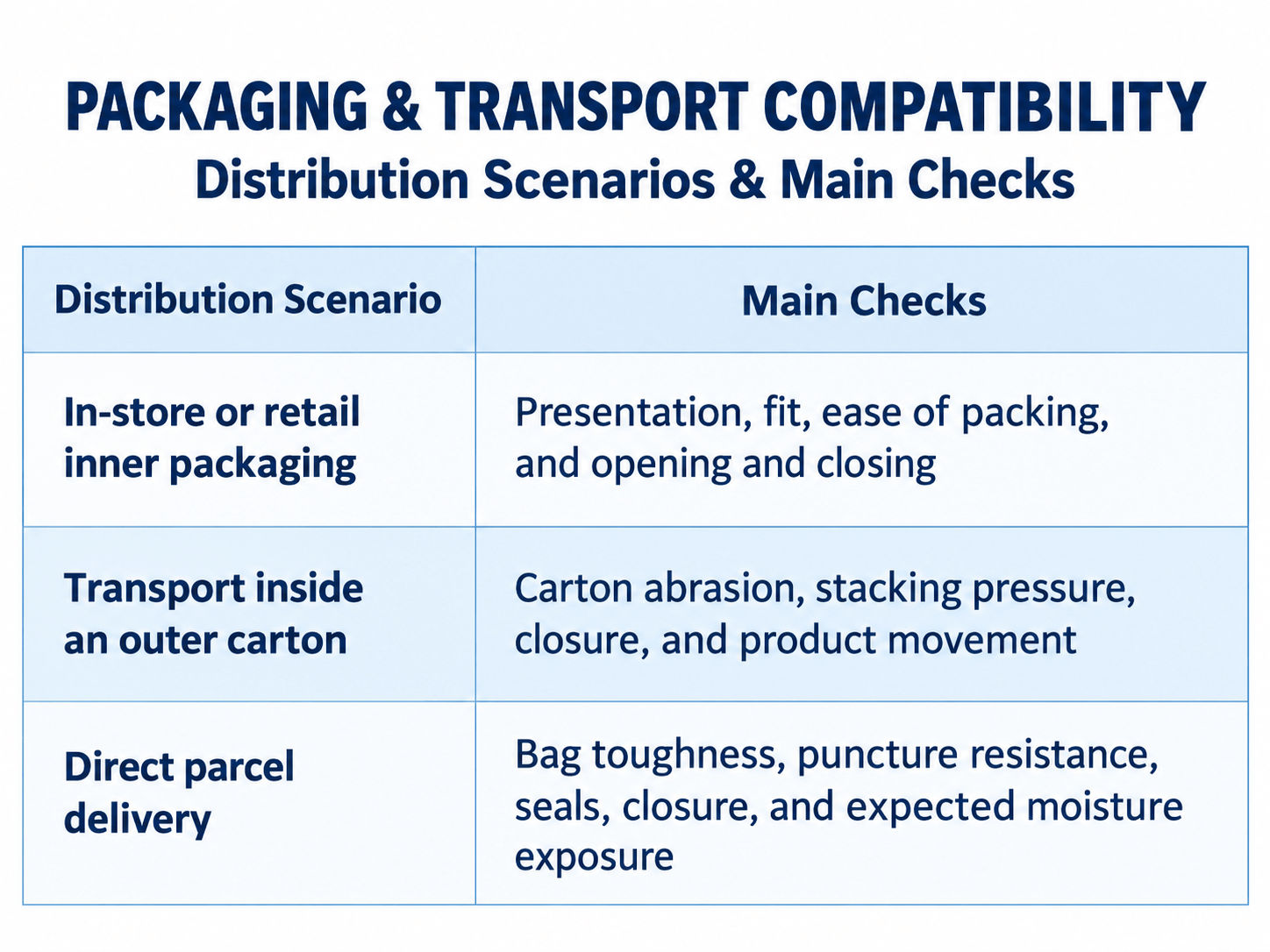
For footwear, heavy garments, and bags with hardware, pay particular attention to concentrated loads and puncture risks. Protective inserts, inner bags, or outer cartons may be needed; increasing bag thickness alone may not resolve the problem.
Transport testing should use the actual product in the completed, sealed packaging. The ISTA test-procedure guidance can help buyers and suppliers identify an appropriate testing approach.
Step 5: Use Samples to Finalize Production Specifications
Test representative products, including the heaviest and thickest items, as well as products with prominent hardware or sharp edges. Once fit, closure, seals, printing, and transport performance have been approved, document the results in the order specification.
Production records should define:
- Material and composition.
- Whether dimensions are internal, external, or finished.
- Dimensional tolerances.
- Single-layer thickness or paper basis weight.
- Closure and gusset construction.
- Artwork revision and color reference.
- Inspection methods and acceptance criteria.
Changes to materials or construction
require a review of the affected items.
Environmental requirements should also be verified separately. For example, Textile Exchange’s GRS overview explains recycled-content and chain-of-custody requirements. Certification claims do not replace load-bearing or transport tests.
Guanglian’s Specification Development and Custom Manufacturing Capabilities
Guanglian supports custom sizes and branded
printing for recycled PE/CPE and other plastic packaging, PLA/PBAT compostable
packaging, glassine paper, and cellulose film packaging. Our capabilities cover
flat bags, self-adhesive bags, press-to-close zipper bags, slider zipper bags,
and mailers. Across the relevant product categories, our certification
portfolio includes OK compost HOME, OK compost INDUSTRIAL, EN 13432, GRS, EN
15343, and FSC. Applicable materials and supporting documents are matched to
each project’s environmental requirements.
By coordinating material selection, bag
construction, printing, bag making, and finished-product inspection, we
translate initial requirements into practical manufacturing specifications
through packing trials and sample approval. We help brands in apparel,
footwear, bags, and home textiles meet their requirements for product
presentation, closure performance, and bulk supply.
Share your folded product dimensions, weight, quantity per bag, shipping method, artwork, and certification requirements so Guanglian can evaluate a suitable custom packaging solution.