
How to Approve Custom Sustainable Packaging Bag Samples
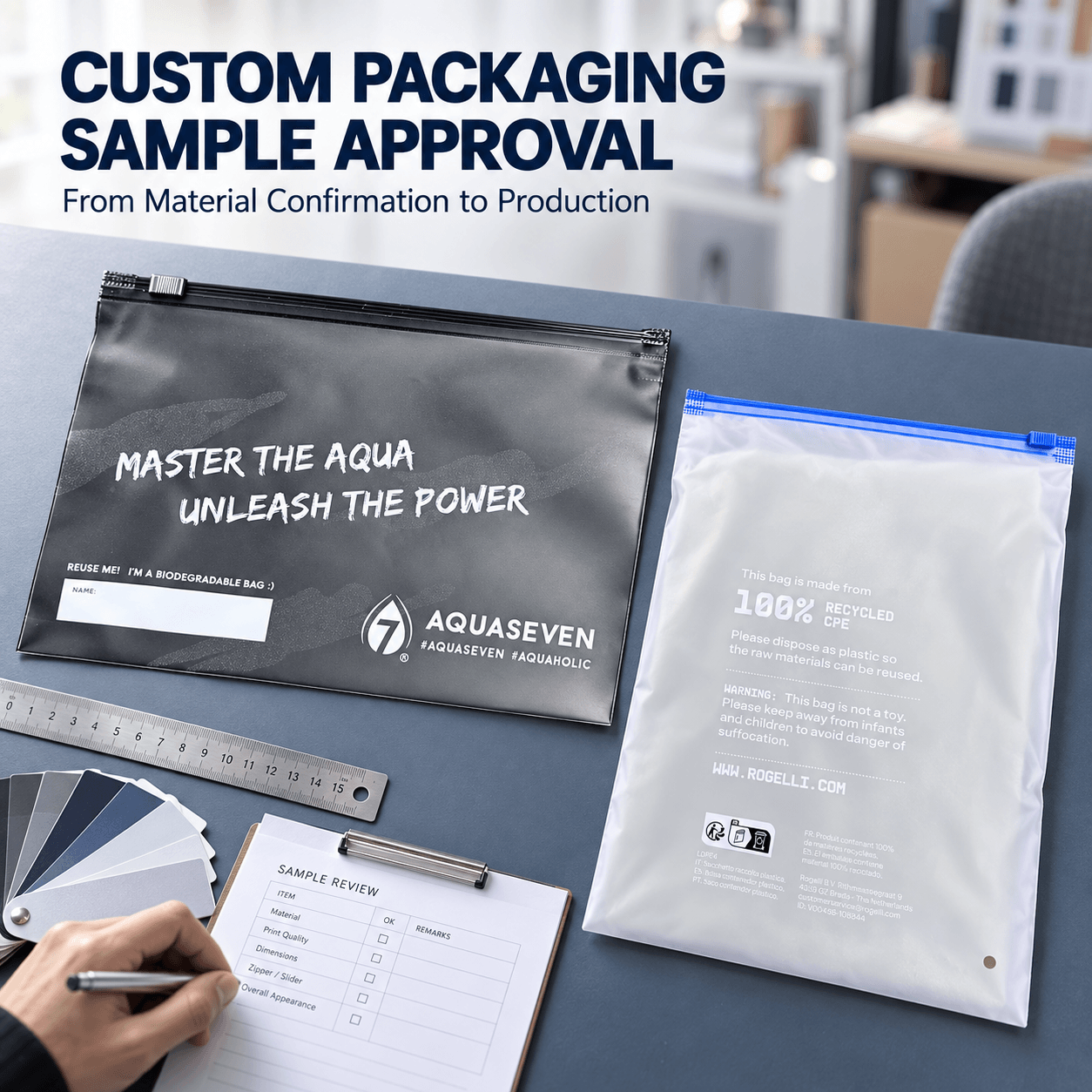
What can material samples, unprinted bags, digital proofs, and printed samples confirm? Can production begin as soon as the digital artwork is approved?
Each sample serves a different purpose.
Buyers should verify materials, bag construction, printing, and functional
performance, then document the approved requirements as the basis for
production and inspection.
Common Questions About Sample Approval
Can production start after digital proof approval?
A digital proof primarily confirms text, graphics, print position, orientation, and file revision. It does not replace checks of material feel, physical color, product fit, or closure performance. The need for physical sampling should be agreed according to project complexity.
Why can bulk production differ from an approved sample?
Raw-material batches, ink preparation, machine settings, and processing conditions can affect the finished bag. Simply requesting “the same as the sample” can lead to misunderstandings if dimensional tolerances, color references, and inspection criteria are undefined. Physical sample approval should therefore be supported by written specifications.
Does every order require every sample type?
No. New materials, new bag designs, and complex printing generally require more extensive verification. Repeat orders with unchanged specifications may use reviewed approval records. The key is to identify what each sample approves and what remains outstanding.
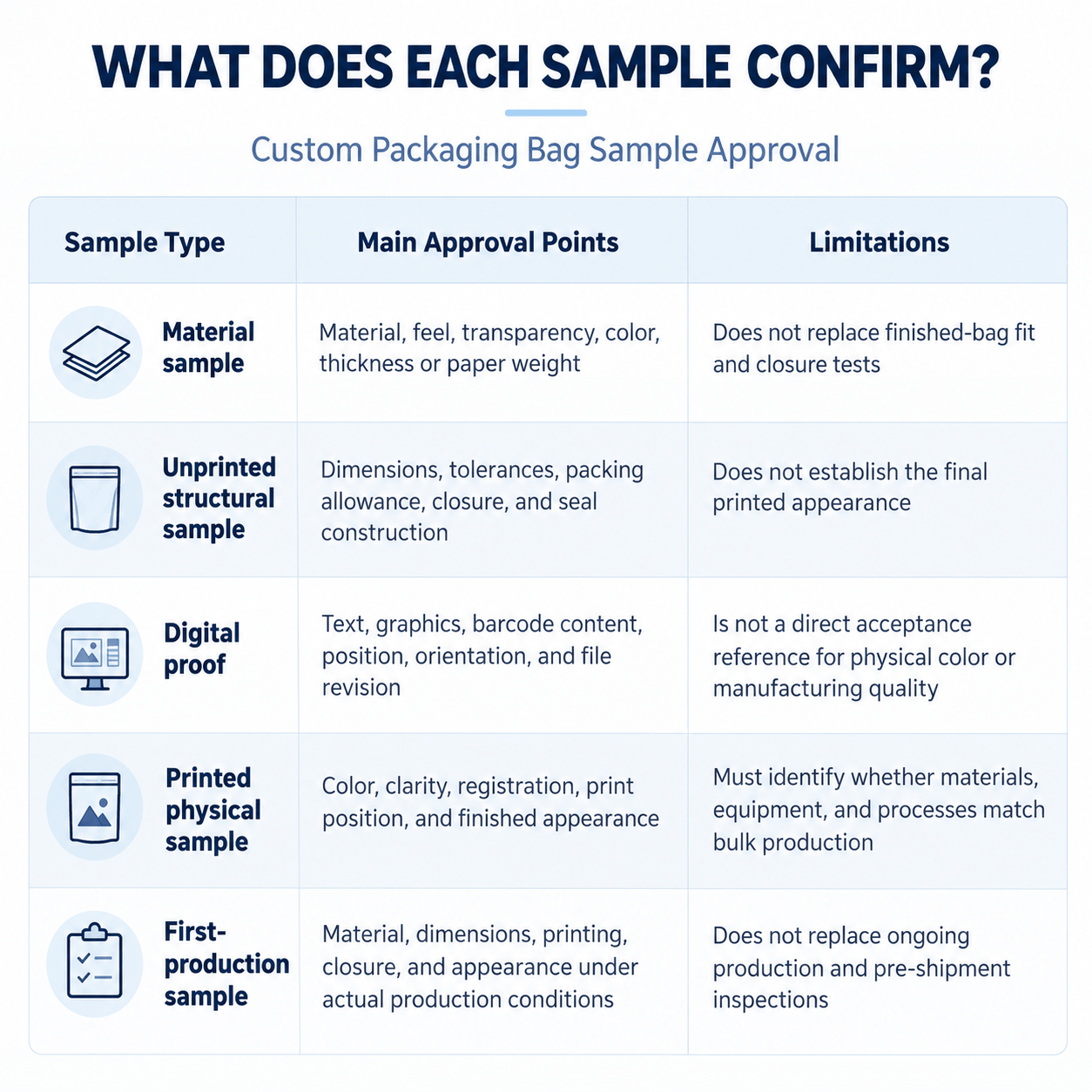
If a printed prototype uses different materials or processes from bulk production, its approval scope should be stated clearly. A presentation mockup should not be treated as a complete production acceptance reference.
The Approval Process: From Sampling to Production
Define the packaging application, material
and environmental requirements, thickness or paper weight, dimensions and
tolerances, closure construction, artwork, color reference, and order quantity.
Also agree on the MOQ, sampling charges, estimated schedule, and approval
responsibilities.
Step 2: Verify the Material and Bag
Construction
Pack the actual product into the sample.
Check packing allowance, ease of insertion, closure operation, and seal
performance. For self-adhesive, press-to-close zipper, and slider zipper bags,
evaluate the relevant adhesive or closing function against the intended use.
Step 3: Review Digital Artwork and Printed
Samples
Approve the digital content, placement, and
revision first, then assess a printed physical sample where required. Use an
agreed physical color sample or color standard as the reference. Barcodes
intended for scanning should be checked on the finished sample.
Step 4: Approve Samples and Lock Production
Records
Record the sample identifier, approval
date, file revision, approval scope, and outstanding issues through signatures
or another mutually accepted written method. Both parties should retain
matching reference samples and link the material specification, artwork, color
reference, and inspection requirements to the same order.
Step 5: Verify First Production
Compare initial production output with the approved sample and order specification before release according to the agreed procedure. Resolve deviations first. Changes to materials, dimensions, artwork, or closure construction require renewed approval of the affected items. Continue production and pre-shipment inspections after first-sample approval.
Material-Specific Checks for Sustainable
Packaging
Recycled plastic bags: Check thickness,
appearance, feel, printing, and seals alongside recycled-content documentation,
certification scope, and traceability records. A GRS claim does not replace
finished-bag quality approval. See Textile
Exchange’s GRS overview.
PLA/PBAT bags: Check thickness,
flexibility, closure performance, and storage suitability. Verify whether
compostability evidence covers the selected construction. Bio-based,
biodegradable, and compostable claims should be assessed separately, as
explained in the European
Commission’s policy framework.
Glassine paper bags: Check paper weight,
translucency, folding behavior, adhesive compatibility, and resistance to
tearing around bonded seams. Where an FSC claim is required, verify the
certification scope and order documentation. See FSC’s Chain of Custody guidance.
Cellulose film bags: Check clarity,
thickness, creasing, printing, self-adhesive closure, and edge seals. Confirm
storage requirements and the evidence supporting environmental claims for the
specific finished construction.
Document verification and physical performance testing should proceed together. When materials or construction change, review whether the existing evidence remains applicable.
Guanglian’s Custom Sampling and Production
Capabilities
Dongguan Guanglian New Materials Co., Ltd.
has 23 years of packaging industry experience, with 35 production lines and an
overall factory capacity of approximately two million bags per day. Our
integrated manufacturing capabilities include film extrusion, up to eight-color
printing, and bag making. We undertake custom packaging projects using recycled
plastics, PLA/PBAT, glassine paper, and cellulose film, with custom sizes,
branded printing, and OEM/ODM support.
Across the relevant material and product categories, our certification portfolio includes OK compost HOME, OK compost INDUSTRIAL, EN 13432, GRS, EN 15343, and FSC. Applicable documents are matched to the customer’s selected material and environmental requirements. For flat bags, self-adhesive bags, press-to-close zipper bags, slider zipper bags, and mailers, Guanglian evaluates samples according to product dimensions, packing methods, artwork, and closure needs. We use mutually approved samples, specifications, and file revisions to guide manufacturing and inspection, supporting apparel, footwear, bags, home textile, and consumer goods brands from development sampling through bulk procurement.