A Scientific Guide to Carbon Footprint Accounting for Custom Packaging
A Scientific Guide to Carbon Footprint Accounting for Custom Packaging
How fashion, footwear and luggage brands can make fair packaging comparisons, avoid misleading green claims and improve sustainable packaging procurement.
Sustainable packaging is becoming an important part of brand development. Recycled plastic bags, compostable film, cellulose film and glassine paper packaging may all appear to be environmentally preferable. However, a packaging solution should not be judged only by its material name, certification or weight.
A reliable packaging decision requires scientific carbon footprint accounting, a fair comparison between equivalent packaging formats, evidence-based green claims and a procurement process that considers performance, transport and end-of-life treatment.
Why Packaging Weight Alone Cannot Prove a Lower Carbon Footprint
A common mistake is to compare two packages only by material weight. A lightweight bag may use less material, but it may require a thicker film, stronger components or additional replacement packaging if it does not provide sufficient protection.
A heavier package may have a similar or lower overall impact if it provides better tear resistance, stronger sealing, improved product protection or a longer service life.
The correct question is: Which packaging solution provides the required function with the lowest verified life-cycle greenhouse gas emissions?
What Is a Packaging Carbon Footprint?
A packaging carbon footprint is the total greenhouse gas emissions and removals associated with a defined packaging unit throughout a specified life cycle. Results are commonly expressed as:
- g CO2e per finished package
- kg CO2e per 1,000 packages
ISO 14067 provides principles, requirements and guidelines for quantifying and reporting the carbon footprint of products in line with life-cycle assessment standards ISO 14040 and ISO 14044.
Depending on the selected boundary, packaging carbon accounting may include raw material production, recycled material processing, film or paper manufacturing, printing, converting, bag making, transport, use and end-of-life treatment.
The calculation boundary must always be stated clearly. A cradle-to-gate result should not be presented as a complete life-cycle carbon footprint.
Define the Functional Unit Before Comparing Materials
A fair packaging comparison starts with a functional unit. The functional unit explains what the package must do.
For a fashion brand, a suitable functional unit could be:
One package capable of protecting one folded garment during factory handling, international transport, warehouse storage and final delivery.
Recycled PE, PLA+PBAT, cellulose film and glassine paper should only be compared when they are designed to perform the same packaging function.
Before calculating the carbon footprint, define:
- Finished bag dimensions
- Material structure
- Thickness or grammage
- Bag type and opening method
- Printing coverage and ink type
- Required load and product weight
- Expected number of uses
- Transport distance and transport mode
- End-of-life or recovery route
- Minimum performance requirements
Set the Carbon Accounting Boundary
The GHG Protocol Product Life Cycle Accounting and Reporting Standard helps companies understand emissions throughout a product’s life cycle and identify important reduction opportunities.
Raw Materials
The calculation should identify the actual materials used, including:
- Virgin PE, PP, OPP, PO, CPE and other polymers
- Post-consumer or post-industrial recycled content
- PLA, PBAT and starch-based materials
- Glassine paper and kraft paper
- Cellulose film
- Inks, adhesives, zippers, sliders and labels
General descriptions such as “eco film” or “biodegradable plastic” are not sufficient for a reliable carbon calculation.
Manufacturing
Relevant manufacturing stages may include:
- Film blowing or film extrusion
- Paper production or cellulose film formation
- Printing
- Lamination, where applicable
- Cutting, sealing and bag making
- Quality inspection
- Production waste and rejected bags
If different production sites are used, the calculation should identify the actual manufacturing site for the order.
Transport and Distribution
Transport emissions depend on the transport mode, shipment weight, shipment volume, container utilization, delivery route and whether the packaging is shipped flat or assembled.
A compact package may reduce warehouse and transport space even when its material emission factor is not the lowest.
Packaging Use
Brands should consider:
- Whether the package is used once or multiple times
- Whether it replaces secondary packaging
- Whether it prevents product damage
- Whether it can be reused for returns
- Whether its closure can be opened and resealed
Better product protection may reduce replacement products, reverse logistics and additional packaging.
End of Life
End-of-life assumptions must match the actual waste infrastructure in the target market. Possible routes include:
- Mechanical recycling
- Industrial composting
- Home composting
- Incineration with or without energy recovery
- Landfill
- Mixed municipal waste treatment
A material should not be described as low carbon simply because it is recyclable or compostable. The actual result depends on collection, sorting and treatment conditions.
Use Reliable Data for Carbon Footprint Accounting
A credible calculation should combine primary production data with transparent and appropriate secondary data.
Primary Data May Include
- Actual material weight per bag
- Confirmed recycled content
- Factory electricity consumption
- Production output
- Printing and converting energy
- Production scrap rate
- Shipment weight and route
- Actual bag dimensions and specifications
Secondary Data May Include
- Published material emission factors
- Recognized life-cycle databases
- Grid electricity factors
- Standard freight emission factors
- Waste treatment assumptions
Each important input should be recorded with its source, date, geographic scope and unit. When industry-average data is used, this limitation should be disclosed.
Recycled Content and Carbon Footprint Are Different Claims
Recycled content can reduce reliance on virgin raw materials, but it does not automatically prove a lower carbon footprint. The result depends on the source of the recycled material, processing energy, allocation method, recycled percentage, manufacturing losses and end-of-life route.
GRS certification can support certified recycled material and chain-of- custody claims. EN 15343 can support recycled plastics traceability and recycled content verification. However, these certifications do not automatically prove that a package has the lowest carbon footprint.
A recycled-content claim should identify:
- Material type
- Recycled content percentage
- Calculation basis by total package weight
- Applicable certificate or transaction certificate
- Product specification covered by the evidence
- Carbon footprint boundary, if a carbon claim is made
Compostable Packaging Requires a Separate Assessment
“Compostable” describes a specific end-of-life property under defined conditions. It does not automatically mean that the package has lower greenhouse gas emissions than recycled plastic or paper.
Brands should verify:
- Whether the package is home or industrially compostable
- Which standard or certification applies
- The required composting conditions
- Whether suitable collection infrastructure exists
- Whether inks, adhesives and closures affect compostability
- Whether the full package or only one layer is certified
EN 13432 and certifications such as OK compost INDUSTRIAL or OK compost HOME address compostability under defined conditions. The claim must match the certified product structure.
A compostable package should therefore be evaluated through two separate questions:
- Does it meet the relevant compostability requirements?
- What is its verified carbon footprint under the selected boundary?
How to Make a Fair Packaging Comparison
| Comparison Factor | Questions to Ask |
|---|---|
| Function | Do all packages protect the same product? |
| Size | Are the dimensions and usable capacity equivalent? |
| Weight | Are closures, labels and other components included? |
| Material | Are structures and additives fully disclosed? |
| Manufacturing | Are printing, sealing, converting and scrap included? |
| Transport | Are route, mode, weight and volume comparable? |
| End of Life | Is the assumed disposal route available locally? |
| Evidence | Are certificates, reports and calculations traceable? |
| Performance | Does the package meet tear, seal, moisture and load requirements? |
| Carbon Result | Is the same functional unit and boundary used? |
Use Specific and Evidence-Based Green Claims
Environmental claims may become misleading when they are broad, absolute or disconnected from the finished product evidence.
High-risk examples include:
- 100% eco-friendly packaging
- Zero-impact packaging
- Carbon-free packaging
- Biodegradable everywhere
- Recyclable in all markets
- The most sustainable packaging
More precise claims include:
- Made with 50% post-consumer recycled PE by package weight
- Industrially compostable under certified conditions
- Plastic-free glassine paper packaging
- Cradle-to-gate carbon footprint calculated using stated data
The claim should identify its scope, evidence, conditions and limitations. A cradle-to-gate result should not be described as a total life-cycle carbon footprint.
Packaging Environmental Compliance
Carbon footprint accounting is only one part of environmental compliance. Packaging procurement should also review:
- Material composition
- Recycled content documentation
- Recyclability or compostability evidence
- Chemical restrictions
- Product safety requirements
- Supplier traceability
- Packaging weight minimization
- Labelling requirements
- Waste management conditions
- Destination-market regulations
The EU Packaging and Packaging Waste Regulation, Regulation (EU) 2025/40 , establishes sustainability and labelling requirements across the packaging life cycle.
This regulation should be reviewed together with the product specification, certificate scope, technical documents and destination- market requirements. A voluntary certification does not replace legal compliance.
A Practical Packaging Procurement Workflow
Step 1: Define the Packaging Function
Record the product, dimensions, expected load, delivery route, closure requirements and performance targets.
Step 2: Select Suitable Material Routes
Depending on the project, options may include:
- Recycled PE, OPP, PP, PO or CPE
- PLA+PBAT compostable film
- Cellulose film
- FSC-related glassine or kraft paper
- Customized composite structures
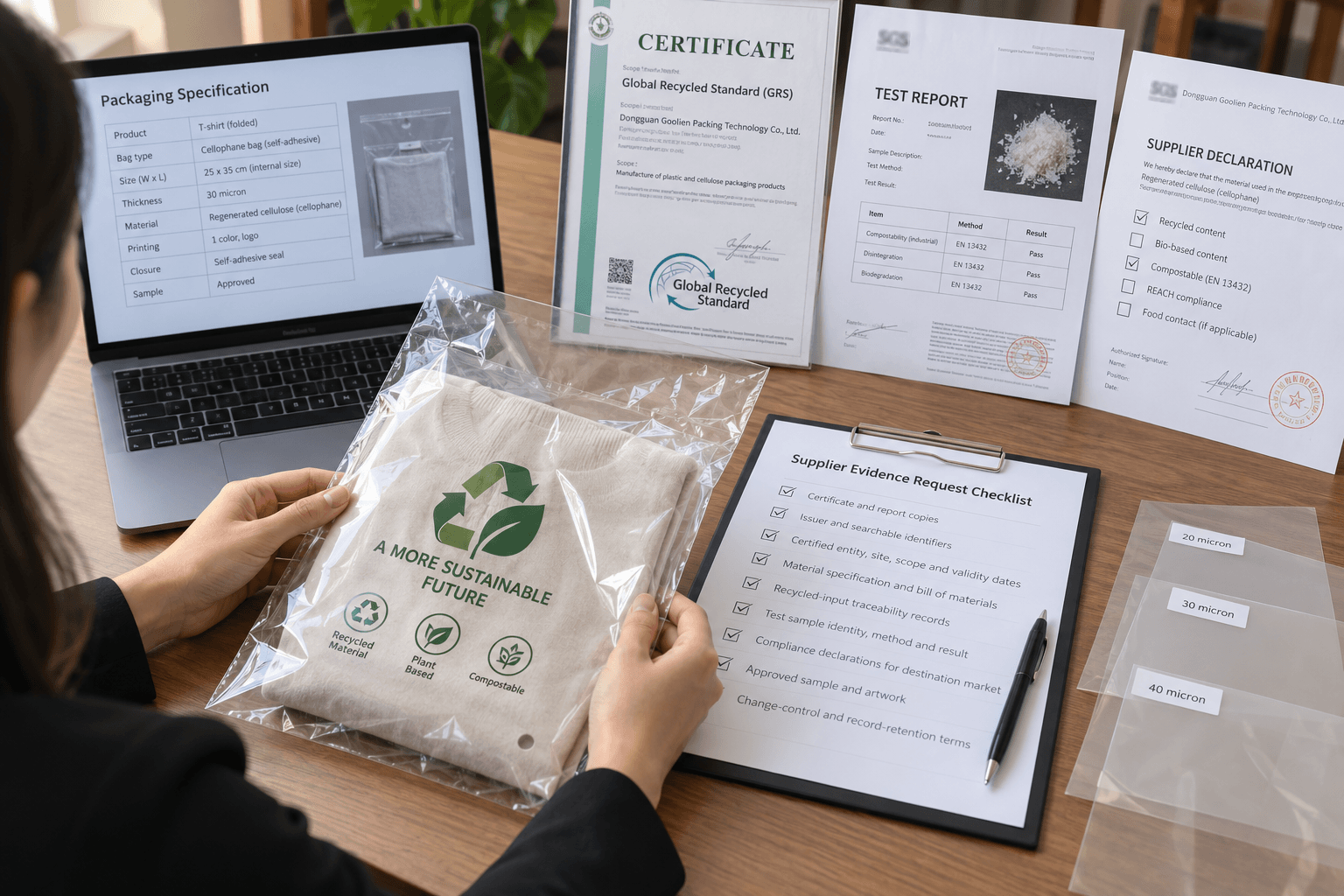
Step 3: Request a Complete Technical Data Pack
- Material structure
- Thickness or grammage
- Finished weight
- Recycled or compostable content
- Certificate numbers and scope
- Printing and adhesive information
- Production site
- Test reports
- Carbon footprint boundary and assumptions
Step 4: Compare Equivalent Solutions
Use the same functional unit, size, performance criteria, order quantity, transport assumptions and end-of-life scenario.
Step 5: Verify Environmental Claims
Match every claim to a certificate, test report, calculation or supplier declaration. Confirm that the evidence applies to the finished package rather than only to one raw material.
Step 6: Approve a Physical Sample
- Seal strength
- Tear resistance
- Closure performance
- Transparency or opacity
- Product fit
- Printing quality
- Handling and transport performance
Step 7: Record the Approved Specification
Keep the final material structure, artwork, dimensions, certificate references, calculation assumptions and change-control requirements in the purchasing record.
Why Choose Dongguan Goolien for Custom Sustainable Packaging?
Accurate carbon footprint accounting and environmental compliance begin with complete product information. A reliable packaging manufacturer should be able to provide clear material specifications, stable production quality, traceable documentation and flexible customization support.
Dongguan Goolien Packing Technology Co., Ltd. is an experienced OEM and ODM manufacturer of sustainable custom packaging for fashion, footwear, luggage, toys, home textiles and consumer brands. With more than 23 years of manufacturing experience, we provide integrated packaging solutions from material selection and film production to printing, bag making and quality inspection.
Our sustainable packaging solutions cover three main material routes: recycled materials, compostable materials and paper-based packaging. Depending on the project, customers can choose recycled PE, OPP, PP, PO or CPE packaging, PLA+PBAT compostable bags, cellulose film bags, glassine paper bags and other customized structures.
Our Packaging Capabilities
- GRS and EN 15343 recycled packaging solutions
- EN 13432 and OK compost-related packaging options
- FSC-related paper packaging solutions
- Custom printing and custom sizes for all product categories
- In-house film production, printing and bag manufacturing
- OEM and ODM support for global brand packaging projects
- 48-hour artwork support
- Approximately 7-day sample turnaround
- 7×24 project communication support
Our approximately 5,000-square-meter production base integrates film blowing, high-precision printing and automatic bag making. With 35 production lines and a daily capacity of approximately 2 million bags, we can support both product development and stable large-scale production.
Our integrated manufacturing process helps reduce communication gaps between material selection, printing, converting and final inspection. This also allows customers to confirm packaging specifications more efficiently before mass production.
For every project, our team can help confirm the appropriate material, bag structure, thickness, dimensions, closure method, printing requirements and certification scope. This gives brands a clearer basis for fair packaging comparison, technical review and sustainable packaging procurement.
Whether you need recycled plastic packaging, compostable packaging, cellulose film packaging or paper-based packaging, Dongguan Goolien can provide a customized solution based on your product requirements, target market and sustainability objectives.
Start Your Custom Packaging Project
To receive a suitable packaging recommendation, please provide the product type, bag dimensions, preferred material, expected quantity, printing requirements and destination market.
Our team can then recommend a suitable packaging structure and prepare the corresponding quotation, sample plan, technical information and certification details.
Conclusion
A credible packaging decision depends on evidence, equivalent function and a transparent calculation boundary. Material weight alone cannot determine the best option, and a sustainability label cannot replace a complete assessment.
Brands should combine:
- Carbon footprint accounting
- Functional-unit comparison
- Recycled content or compostability verification
- Product performance testing
- Green-claim review
- Destination-market compliance
- Supplier traceability
This approach allows brands to compare recycled plastic, compostable film, cellulose film and paper-based packaging more fairly while reducing the risk of unsupported environmental claims.
References
Complete Guide to Sustainable Packaging Certification Verification and Compliance